 How-to
How Do You Measure a Door for New Hardware?
Last Updated: November 11, 2026
Quick Summary
To measure door hardware, record four numbers: backset, bore hole diameter, door thickness, and handle spacing. Measure backset from the door edge to the center of the bore hole, which is typically 2 3/8 or 2 3/4 inches. Remove the old knob and latch first so the holes tell you more about fit than the door face does.
- Backset comes in two standard sizes: 2 3/8 inches and 2 3/4 inches.
- Most residential doors use a 2 1/8 inch bore hole diameter.
- Standard interior doors are 1 3/8 inches thick; exterior slabs are 1 3/4 inches.
- Common handle spacing is 5 1/2 inches center to center, but read the actual number.
- Measure thickness at the top, middle, and bottom because doors warp.
Table of Contents
- Tools and Prep Before You Measure for Door Hardware
- How to Measure Door Backset
- How to Measure Door Knob Hole Size
- Standard Door Thickness for Hardware
- How to Measure Door Handle Spacing
- Measuring Door Height, Width, and the Frame Opening
- Matching New Hardware to Nonstandard Doors and Existing Holes
- Bring Your Measurements to Arizona Door Store
- Frequently Asked Questions
Tools and Prep Before You Measure for Door Hardware
Grabbing a tape measure and guessing is how most hardware projects go wrong. When you measure door hardware for a new setup, it takes about ten minutes, and it starts with the right tools on hand before you touch the door.
The steps below walk you through the measurements step by step.
Here is what you need:
- A tape measure (a stiff metal blade works best)
- A pencil and a scrap of paper or worksheet
- A screwdriver to remove the old knob or lever
- A level to check the door and jamb
Door hardware sizing comes down to four numbers: backset, bore hole diameter, door thickness, and handle spacing. Get those right and almost any replacement hardware will fit.
One quick note on prep. Remove the old knob, lever, and latch before you measure. For a walkthrough on getting the hardware off cleanly, see our tips for installing door hardware correctly.
How to Measure Door Backset
Backset is the distance from the door edge to the center of the bore hole. It is the single most important number for buying new hardware, and it comes in two standard sizes: 2 3/8 inches and 2 3/4 inches.
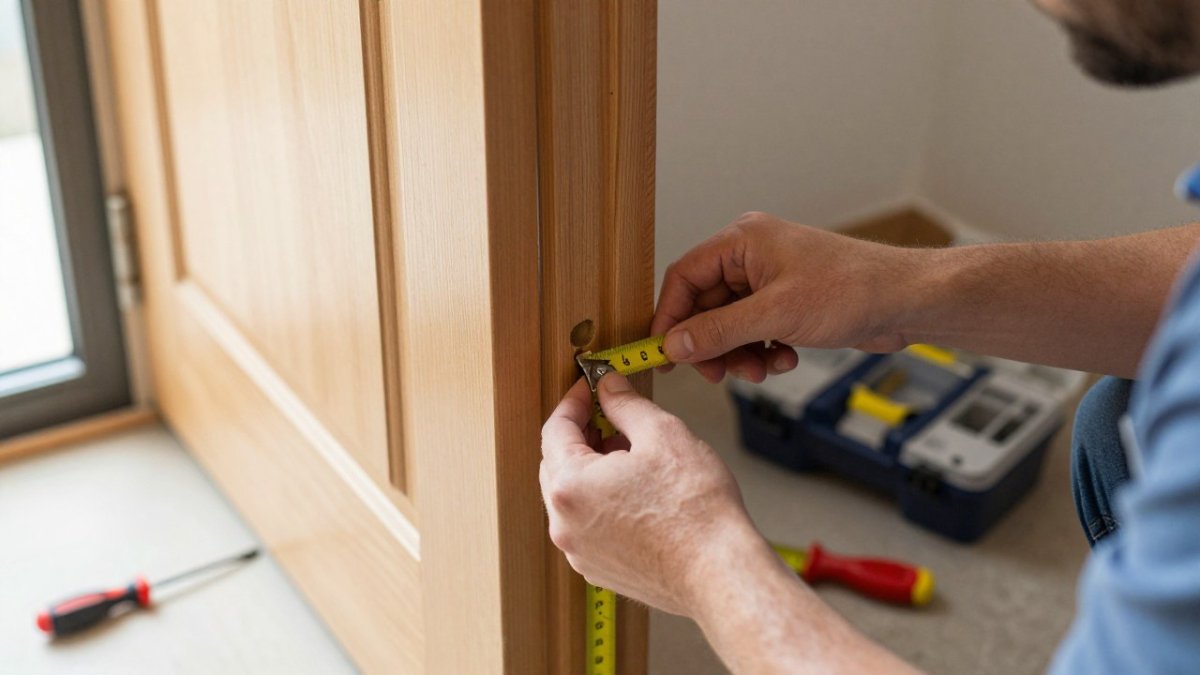
Here is how to measure door backset:
- Hook the tape on the door edge at the latch face.
- Pull straight to the center of the bore hole (the big round hole, not the small latch hole).
- Read the number to the nearest 1/16 inch.
If you get 2 3/8 inches, you have a standard residential backset. If you get 2 3/4 inches, that is the other common size. Anything else means a nonstandard door, and you will need to match the new hardware to the existing hole or adjust the door.
A common mistake is measuring to the edge of the bore hole instead of the center. That small error throws off the whole fit and the new latch will not line up with the strike plate.
How to Measure Door Knob Hole Size
Bore hole size is the diameter of the large round hole through the door face. Most residential doors use a 2 1/8 inch bore, but older doors and specialty doors vary.
Measure across the widest point of the hole, not the narrow side. Write down the number.
Then check the latch hole on the door edge. That smaller hole is usually 1 inch, but it can run smaller on older doors. Both numbers matter because the new latch has to slide into that opening.
If your existing knob has no visible screws, replacing it takes a different approach. Our guide on how to replace old door knobs without screws covers that situation step by step.
Standard Door Thickness for Hardware
Door thickness decides which latch, deadbolt, and handleset will fit. Standard interior doors run 1 3/8 inches thick. Standard exterior and front door slabs run 1 3/4 inches.
Measure thickness at three points: top, middle, and bottom. Doors warp, and a door that reads 1 3/4 inches at the top can read 1 5/8 inches at the bottom.
Why it matters: hardware is built for a specific thickness range. A latch made for a 1 3/8 inch door will not seat correctly in a 1 3/4 inch slab. The spindle and through-bolts will be too short or too long, and the door lever will wobble.
| Hardware Type | Typical Door Thickness | What to Check |
|---|---|---|
| Interior knob or lever | 1 3/8 in | Latch length, spindle length |
| Exterior handleset | 1 3/4 in | Through-bolt length, deadbolt throw |
| Deadbolt | 1 3/4 in | Backset, bore diameter |
| Pocket or barn door | 1 3/8 to 1 3/4 in | Track clearance, edge pull fit |
How to Measure Door Handle Spacing
Handle spacing is the center-to-center distance between the knob or lever bore and the deadbolt bore above it.
Measure it in three steps:
- Mark the center of the lower bore (the knob or lever hole) with a pencil dot.
- Mark the center of the upper bore (the deadbolt hole) with a second dot.
- Hook the tape on one dot and read straight up to the other, to the nearest 1/16 inch.
Common residential spacing is 5 1/2 inches center to center, but older doors, custom builds, and some contemporary handlesets run 4 inches, 5 inches, or 8 inches or more. Do not assume; read the actual number off the door.
While the tape is out, capture the deadbolt's own backset. That is the distance from the door edge to the center of the deadbolt bore, measured the same way as the knob backset.
Check level next. Lay a level across the two center marks, or hold it vertically against the door face between them.
If spacing and level check out, our guide on how to install modern door handles on any interior door walks through the install.
Measuring Door Height, Width, and the Frame Opening
Door slab size and door frame size are different measurements, and mixing them up is the most common ordering error we see.
Measure the slab first:
- Door height: from the top edge to the bottom edge
- Door width: across the face at the top, middle, and bottom
- Door thickness: as covered above
Then measure the door opening and jamb:
- Width between the jambs, at the top, middle, and bottom
- Height from the floor to the head jamb
- Jamb depth, from the face of the wall to the door stop
Standard interior sizes are 80 inches tall and 30, 32, or 36 inches wide. If your numbers land outside those, you have a nonstandard door, and that is fine. Just bring the actual numbers, not the "close enough" ones.
A prehung door comes with its frame, so the opening measurement is what you order from. A door slab is just the door, so the slab measurement is what counts.
Matching New Hardware to Nonstandard Doors and Existing Holes
Old homes and custom builds rarely match the standard sizes, and the right move depends on which measurement is off. Work through this hardware-specific checklist before you buy:
- Backset is 2 3/8 or 2 3/4 inches, or you have confirmed the new hardware accepts the existing backset
- Bore hole diameter is 2 1/8 inches, or the new rosette or backplate is wide enough to cover a larger hole
- Door thickness falls inside the hardware's stated range (commonly 1 3/8 to 1 3/4 inches)
- Handle spacing matches the new handleset, and the bores are level within about 1/16 inch
- Latch hole on the door edge is 1 inch, or the new latch faceplate covers the opening
- Existing screw holes will be hidden by the new trim or filled before installation
When a measurement falls outside the common range, match the fix to the problem:
Oversized bore hole. A bore larger than 2 1/8 inches will not hold a standard knob or lever centered. Options are a larger rosette or backplate that covers the opening, a bore-hole repair sleeve or filler plate sized to the existing hole, or filling and re-boring the door. Covering is the least invasive and usually the right first choice on a door you are not replacing.
Nonstandard backset. A backset that is not 2 3/8 or 2 3/4 inches usually means older preparation. Some hardware lines offer adjustable or extended backsets; otherwise you are matching to the existing hole or re-boring. Do not buy standard-backset hardware and plan to 'make it work', the latch will not line up with the strike plate.
Multiple or extra bores. Doors that have carried more than one lockset often have unused holes. Measure every bore, note which ones the new hardware will use, and confirm the new trim covers the rest.
Thickness outside the range. A door thicker than 1 3/4 inches needs hardware rated for that thickness, or longer through-bolts and spindles. A door thinner than 1 3/8 inches may need shims or a latch designed for the thinner slab.
Latch hole too large or misaligned. If the latch hole on the door edge is oversized or does not line up with the new latch, a latch faceplate with a wider footprint can cover it.
If the holes do not match and covering is not enough, you have three routes: fill and re-bore the door, choose hardware with a larger backplate to cover old holes, or replace the door slab and keep the existing frame. That last route is often the cleanest for older doors with worn holes. Our guide on how to install an interior door slab into an existing frame shows how that works.
Watch out: filling and re-boring a door is unforgiving. A hole drilled a fraction off center will not line up with the strike plate, and you cannot undo it. Measure twice, mark once, and drill last.
Bring Your Measurements to Arizona Door Store
Numbers in hand, the rest is easy. Bring the figures you used to measure door hardware, backset, bore size, thickness, spacing, and opening dimensions, to Arizona Door Store, and our consultants can help you choose hardware that fits.
We are family-owned. As one customer put it, "They are great at showing me products that match my need without trying to sell me the highest price door."
What you get with us:
- Expert customer service from consultants who read measurements daily
- Fast will call service so a project does not stall waiting on parts
- Reliable local delivery to job sites across the Phoenix area and Tucson
- Locally made doors and a deep hardware selection for every budget
Pricing depends on quantity, dates, and delivery, so check the Arizona Door Store website for current prices or ask for a quote. For help picking a style once the fit is settled, our guide on choosing door handles for modern homes is the next stop.
Measuring for new hardware is where most projects succeed or fail, and a wrong backset or bore size means a return trip and a stalled install.
Frequently Asked Questions
Is a 32 inch door exactly 32 inches?
No. A door sold as 32 inches is the nominal size, and the actual door slab usually measures slightly less, often around 31.5 inches wide. That difference matters when you measure door hardware and the frame opening. Always measure the actual slab with a tape measure rather than trusting the label, and check the opening between jambs too. If the gap is tight, take the measurement at the narrowest point so your new hardware and door clear the frame.
Can I replace a door knob without changing the door?
Yes, in most cases. If the existing bore hole and backset match your new hardware, you can swap the knob or lever in under an hour with just a screwdriver. Measure the backset (2 3/8 or 2 3/4 inches) and confirm the cross bore is 2 1/8 inches before buying. If the new hardware needs a different backset, you may need to drill a new latch hole or use an adapter kit, which is a bigger job.
How do I know whether new hardware will fit my existing door?
Compare four measurements: backset, cross bore diameter, door thickness, and handle spacing. Standard backsets are 2 3/8 and 2 3/4 inches, the cross bore is typically 2 1/8 inches, and most interior doors are 1 3/8 inches thick while exterior doors are 1 3/4 inches. If your door falls outside those ranges, note the actual numbers and bring them to a supplier who can match hardware to nonstandard doors.
What measurements should I take before buying a door handle?
Record the backset, the center-to-center distance between the knob and deadbolt if you have one, the bore hole diameter, and the door thickness. Also measure the door width and height in case you are replacing the slab too. Write everything down and photograph the door edge with the tape measure in place. Those notes let a supplier confirm compatibility before you order, which saves return shipping and a second trip.