 ultimate-guide
Choosing Door Handles for Modern Homes: 2026 Guide
Table of Contents
- Start With the Door, Not the Handle
- Door Lever vs Knob Pros and Cons
- Modern Door Handle Finishes That Hold Up
- How to Match Door Hardware With Interior Design
- Choosing Door Handles for High-Traffic and Accessible Rooms
- Smart Locks, Privacy Ratings, and Sustainable Materials
- Common Mistakes When Choosing Door Handles for Modern Homes
- Frequently Asked Questions
Last Updated: September 16, 2026
Start With the Door, Not the Handle
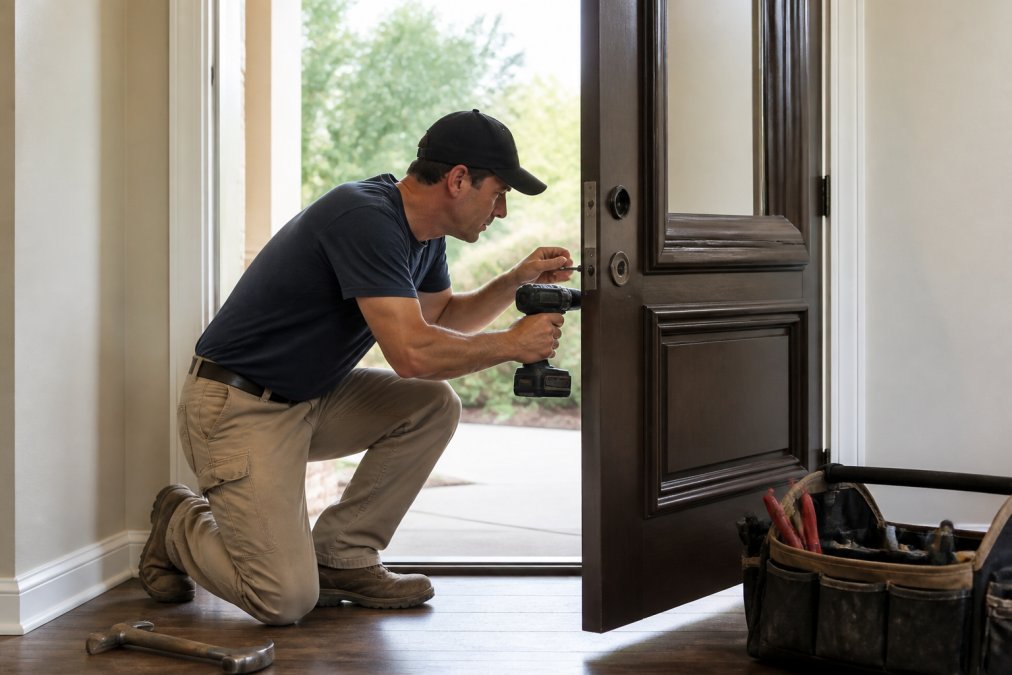
Choosing door handles for modern homes starts with the door, not the showroom display. Most buyers pick a finish, order hardware, then discover the slab is 1-3/8 inches thick instead of 1-3/4, or the bore hole sits at the wrong backset. Mixing them up is the most common ordering error we correct.
Measure Door Thickness and Backset First
Door thickness determines which latch and handle assembly fits without wobble or binding. Interior doors are commonly 1-3/8 inches thick; exterior and many modern interior doors run 1-3/4 inches. Mixing them up is the most common ordering error we correct.
Confirm Handing Before You Order
Handing describes which way a door swings and determines which way the lever or knob faces. Get it wrong and the handle points the wrong direction, or the lock ends up on the wrong side.
- Left-hand: hinges on the left, swings inward
- Right-hand: hinges on the right, swings inward
- Left-hand reverse: hinges on the left, swings outward
- Right-hand reverse: hinges on the right, swings outward
Door Lever vs Knob Pros and Cons
Levers win on accessibility and modern styling; knobs win on tradition and cost.
| Feature | Lever Handle | Door Knob |
|---|---|---|
| Accessibility | Easier to grip and turn | Harder for limited grip |
| Style fit | Modern, contemporary | Traditional, classic |
| Snag risk | Higher in tight spaces | Lower |
| Typical cost | Higher | Lower |
| Wear pattern | Can sag over time | Can loosen at the rose |
Modern Door Handle Finishes That Hold Up
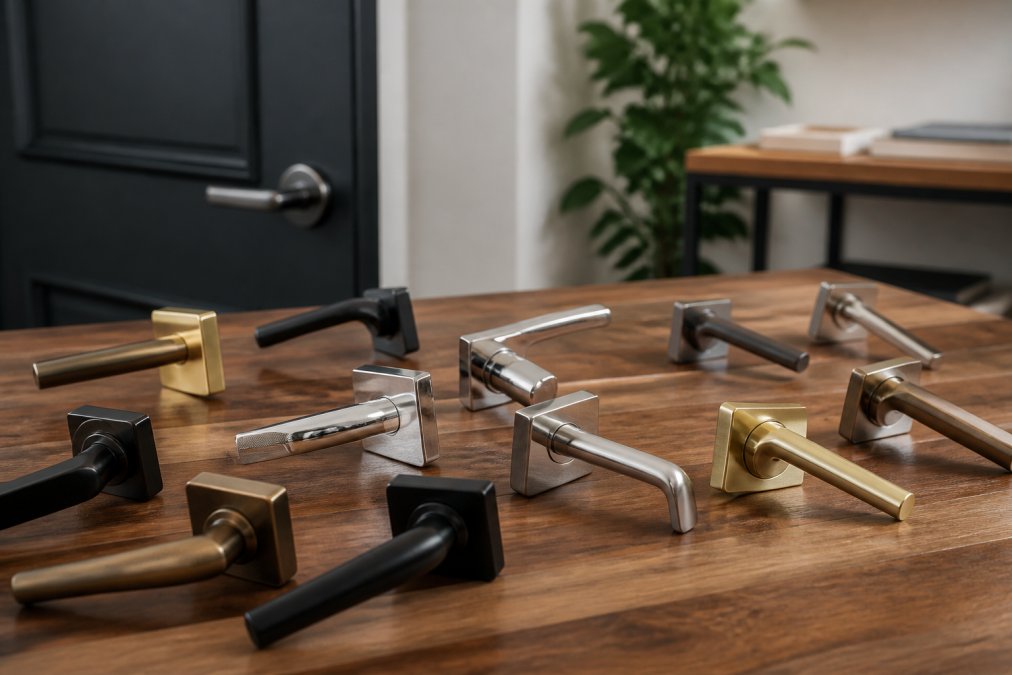
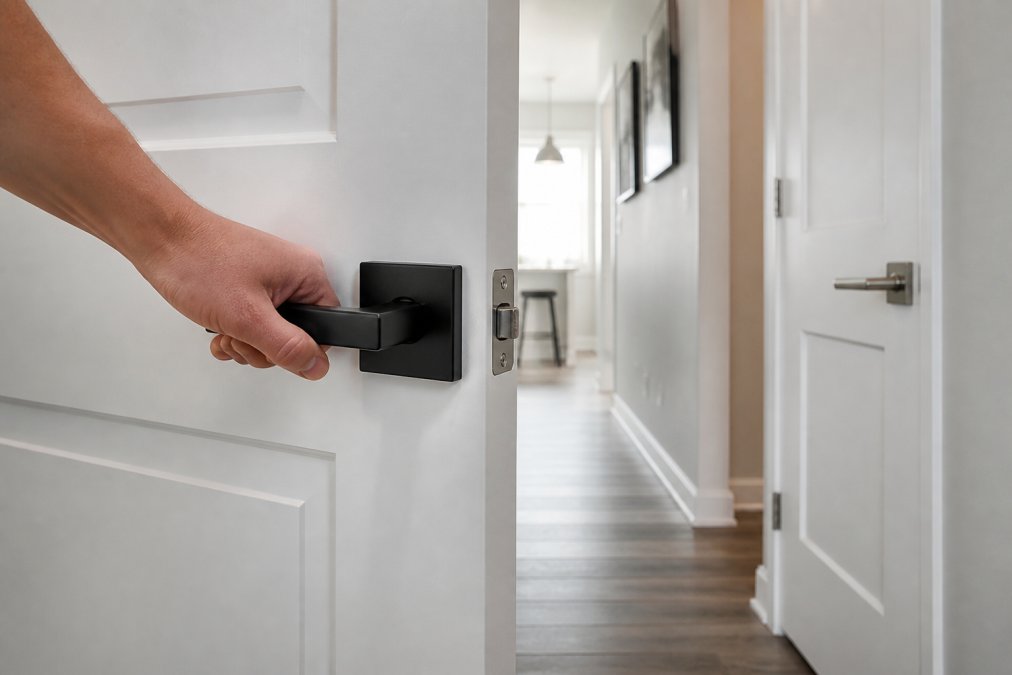
Finish is where the wrong choice shows its age fastest. The finishes dominating modern interiors are matte black, brushed nickel, satin brass, and polished chrome, each with a different tolerance for wear.
How to Match Door Hardware With Interior Design
Matching hardware to a home's aesthetic comes down to three decisions: finish coordination, shape language, and consistency. Get those right and the hardware disappears into the design.
Choosing Door Handles for High-Traffic and Accessible Rooms
High-traffic and accessible spaces demand different hardware than a guest bedroom: function first, style second. The difference between a handle that lasts ten years and one that sags in eighteen months is the internal mechanism, not the finish.
Match the Latch Type to the Door's Job
Door hardware is sold as a latch set, and the set you pick is determined by what the door needs to do:
- Passage set: hallways, closets, no lock. The most abused hardware in any home because it never gets a rest.
- Privacy lock: bathrooms and bedrooms, locks from the inside with a thumb-turn and an emergency release on the outside.
- Dummy handle: closet doors and the inactive side of double doors; no latch at all.
- Keyed entry: exterior doors, locks from both sides.
The Mechanism Inside the Handle Matters More Than the Finish
A lever's internal mechanism fails first. Hollow zinc-alloy levers with a stamped spring pack droop within a few years on a high-traffic door; solid brass or stainless steel internals with a coil spring hold tension far longer. If a lever feels light for its size, the mechanism is thin.
For high-traffic doors, look for:
- Solid brass, stainless steel, or forged construction rather than hollow zinc alloy.
- A through-bolted rosette or backplate that clamps both sides of the door together, rather than two halves screwed in independently. Through-bolting resists the twisting force that loosens surface-mounted hardware.
- A heavier latch bolt, a 1-inch throw bolt engages the strike plate more deeply than a 1/2-inch bolt and rattles less.
Accessibility: What the Standards Actually Say
Lever handles are the standard accessible-design recommendation because they can be operated with a closed fist or elbow. The relevant U.S. references are the Americans with Disabilities Act (ADA) Standards for Accessible Design, which covers public accommodations and commercial buildings, and ICC A117.1, which many state and local residential codes adopt for accessible dwelling units.
Both point to the same practical rules:
- Operable parts must not require tight grasping, pinching, or twisting of the wrist. A round knob fails this; a lever passes.
- Hardware should be operable with no more than 5 pounds of force. A stiff deadbolt or a knob with a weak spring can exceed this.
- Mounting height for accessible doors is typically 34 to 48 inches above the finished floor.
Don't Forget the Strike Plate
A strike plate that's too small causes rattling doors and weakens home security. Upgrading to a larger strike plate with 3-inch screws that reach the wall framing, instead of 3/4-inch screws that only bite the jamb, strengthens the door against forced entry. It's a cheap improvement most homeowners never make.
Smart Locks, Privacy Ratings, and Sustainable Materials
Three factors separate hardware that ages well from hardware that feels dated in two years: smart lock compatibility, sound control, and material sourcing.
Smart Lock Integration Without Ruining the Look
The design tension with smart locks is simple: the electronics live in the interior assembly, which is bulkier and less elegant than the exterior handle. Choose a lock whose interior escutcheon matches your other hardware's finish and shape language, and accept that the interior side reads as more utilitarian.
- Door thickness: most smart locks are built for 1-3/8 to 1-3/4 inch doors. A thicker custom slab may not fit.
- Backset: 2-3/8 or 2-3/4 inches. Some smart locks ship with an adjustable latch; some do not.
- Cross-bore diameter: typically 2-1/8 inches. A non-standard bore from an older retrofit can block installation.
- Interior clearance: the interior assembly needs room to sit flat against the door without hitting the door stop or trim when the door closes.
Two more practical points:
- Deadbolt vs. handle set. A smart deadbolt replaces only the lock cylinder and thumb-turn; you keep your existing handle. A smart handle set replaces the whole assembly. If you love your current lever, the deadbolt route preserves it.
- Power and connectivity. Battery life varies widely by model and by how often the lock is used; check the manufacturer's stated range and whether the lock warns you before the battery dies. If the lock relies on a hub or bridge for remote access, that is a separate device to power and place.
Acoustic and Privacy Ratings: The Part Hardware Can and Can't Fix
Sound control is a system, not a product. The handle contributes less than most buyers assume; the door slab and the gaps around it do most of the work.
- Solid-core doors block noticeably more sound than hollow-core doors of the same thickness. If a bedroom shares a wall with a living room, the slab is the first upgrade.
- A tight latch and strike plate reduce the rattle that transmits through a loose door, but they do not stop airborne sound.
- Weatherstripping and door sweeps seal the perimeter gap. For a home office or a bedroom near a noisy hallway, sealing the gap around the frame does more for perceived privacy than swapping the handle.
Sustainable and Eco-friendly Material Sourcing
Hardware is small, but it's metal, and metal sourcing is where sustainability questions get answered.
- Recycled content. Brass and stainless steel are highly recyclable, and many manufacturers publish recycled-content percentages. Ask for it; if a maker can't answer, that's an answer.
- PVD finishes. Physical vapor deposition bonds the finish to the substrate at a molecular level in a vacuum. It uses no liquid plating baths and produces a far more chip-resistant surface than painted or electroplated finishes, avoiding traditional plating's chemical waste streams.
- Low-VOC and powder-coat finishes. Powder coating emits no solvent VOCs and produces a durable, chip-resistant film. For matte black hardware, powder coat and PVD survive years of hand contact without exposing base metal.
- Wood sourcing. If you are buying a door and hardware together, look for doors certified by the Forest Stewardship Council, which verifies responsibly managed wood sourcing.
Common Mistakes When Choosing Door Handles for Modern Homes
These mistakes account for most hardware returns and rework we see on residential projects, and each is avoidable with a tape measure and five minutes of planning.
- Ordering before measuring. Thickness, backset, and handing must be confirmed first.
- Mixing finishes without a rule. Two finishes applied consistently look intentional; five look careless.
- Choosing style over durability in high-traffic areas. A light lever on a kitchen door will sag.
- Ignoring accessibility. Knobs fail anyone with limited grip strength.
- Skipping smart lock compatibility checks. A great lock that won't fit your door is worthless.
- Underestimating sound and privacy. Loose hardware and gaps undermine both.
Frequently Asked Questions
What are the door handle trends for 2026?
Matte black and satin brass remain the two most requested finishes for modern homes, with brushed nickel holding steady for transitional interiors. Lever handles continue to outsell knobs in new construction because they meet accessibility expectations and work with smart lock retrofits. Mixed finishes within one home are now common, provided the metal tone repeats at least twice per sightline.
Do door handles need to match throughout the house?
They do not need to match exactly, but they should coordinate. A common approach is one finish for all interior passage and privacy doors, then a different but complementary finish for exterior entry hardware. Repeating the same metal tone at least twice in any open sightline keeps the look intentional rather than accidental.
What is the difference between a door lever and a door knob for modern interiors?
Levers operate with a downward push, so they work without a tight grip and suit aging-in-place designs. Knobs require rotation, which can be harder for children or anyone with limited hand strength. Levers also pair more easily with smart lock conversions, while knobs often appeal in traditional or heritage-style homes where the round profile fits the trim.
How do I choose the right finish for modern door hardware?
Match the finish to the metal already in the room. If your faucets and cabinet pulls are brushed nickel, stay in that family. Matte black reads well against white doors and light walls, satin brass warms up cool gray palettes, and polished chrome suits high-contrast contemporary spaces. Bring a door sample and a cabinet pull to the showroom so you can see the finishes under the same light.
Are matte black door handles still in style for modern homes?
Yes. Matte black has stayed popular because it hides fingerprints better than polished chrome and contrasts sharply against white or light oak doors. It works across farmhouse, industrial, and minimalist interiors. The main caution is on exterior doors in full sun, where lower-quality black finishes can fade faster than brushed nickel or satin brass.
What should I consider when selecting door hardware for high-traffic areas?
Look for solid brass or stainless steel construction rather than hollow zinc or plated steel. Heavier levers with a firm spring return hold up better in hallways, kitchens, and mudrooms. Also check the latch and strike plate: a tubular latch with a reinforced strike plate reduces wear and rattle far more than the visible handle does.
Getting door hardware right is a compatibility problem before it's a design problem. Measure the door, confirm the handing, pick a finish you can live with for a decade, and match the function to the room. Arizona Door Store can help with all of it: locally made doors, expert customer service from consultants who know the specs, and reliable local delivery to Scottsdale, Phoenix, and Tucson. Get started with Arizona Door Store and order hardware that fits the first time.