 ultimate-guide
Cost Factors for Custom Door Installation in Arizona
Last Updated: October 22, 2026
Quick Summary
The cost factors for custom door installation in Arizona come down to five quote buckets: the door slab, frame and jamb, hardware and finish, labor, and disposal or site work. Desert heat and UV push many buyers toward fiberglass, steel, or engineered wood, while out-of-square openings in older Phoenix-area homes add adjustment time and frame rebuild work.
- Compare the frame and labor lines first, since the slab is often the smallest variable in a quote.
- Fiberglass and steel slabs often cost more up front than basic wood but hold their finish longer in desert conditions.
- A prehung door in a square opening is fast work, while a custom slab in an out-of-square opening takes shimming and adjustment.
- New construction builds the rough opening to the door, so per-door labor is lower than replacement work.
- Resolve HOA approval before ordering, because a custom door cannot be returned to stock if the style is rejected.
Table of Contents
- What Drives the Cost of Custom Door Installation in Arizona
- Custom Front Door Installation Cost: What Pushes It Higher
- Door Installation Labor Cost and What Crews Charge For
- Door Frame Replacement Cost When the Opening Needs Work
- Using a Door Installation Cost Calculator Without Getting Misled
- New Construction vs. Replacement: How the Scope Changes
- Permits, HOA Rules, and Lead Times That Affect Your Total
- Frequently Asked Questions
What Drives the Cost of Custom Door Installation in Arizona
Custom door installation cost in Arizona rarely comes down to one number. This guide breaks down the cost factors for custom door installation in Arizona so you can read a bid line by line instead of guessing whether it is fair. A custom door is built to your specified dimensions, material, glass, and hardware rather than pulled from stock, so two projects in the same neighborhood can land in very different places.
The Five Cost Buckets in Every Custom Door Quote
Every legitimate quote breaks into the same five parts: the door slab, the frame and jamb, hardware and finish, labor, and disposal or site work. The slab is the door panel; the frame and jamb are the structure it hangs in; hardware covers hinges, locksets, and weatherstripping; labor is the crew's time; site work covers removing the old door and hauling it away.
A common mistake is comparing quotes on the slab price alone. The slab is often the smallest variable; the real spread shows up in frame work and labor, where a cheap bid and a careful bid diverge.
Why Arizona Projects Price Differently
Desert heat, intense sun, and seasonal dust put real demands on door materials. Wood doors that perform fine in milder climates can dry, warp, and split faster under sustained UV and low humidity, pushing many Arizona buyers toward fiberglass, steel, or engineered wood.
Older homes in the Phoenix metro often have uneven floors and walls that are not plumb, which adds adjustment time. Newer builds tend to have more consistent openings.
Custom Front Door Installation Cost: What Pushes It Higher
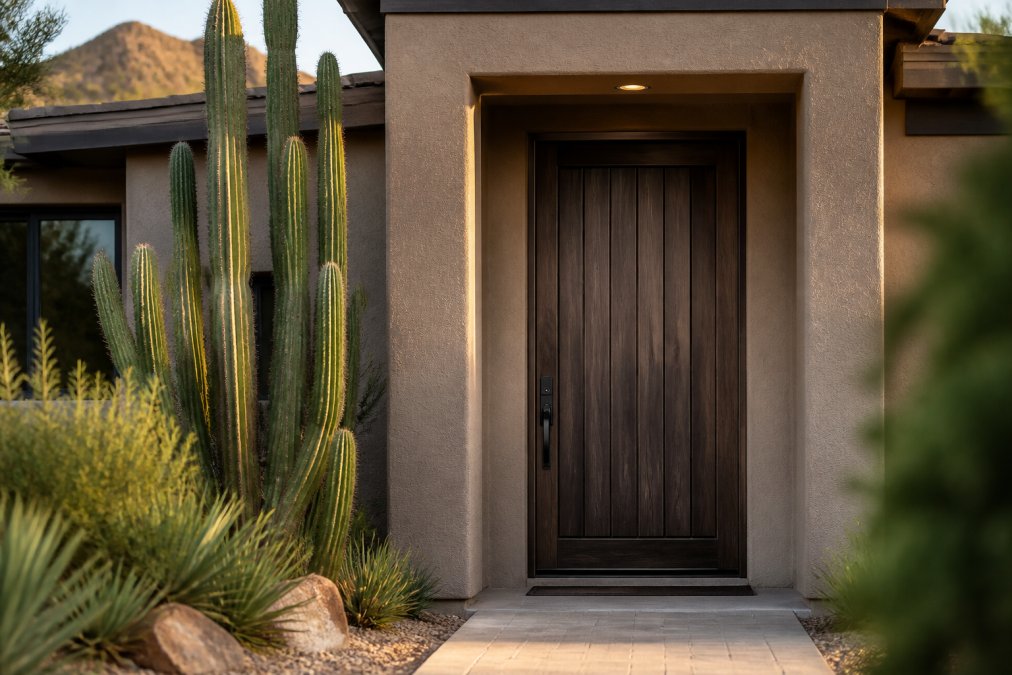
Custom front door installation cost climbs fastest when the entry is oversized, glazed, or structural, but the reason is rarely the door slab alone. The slab is the visible purchase; the cost is in what it demands of the frame, hardware, finish, and crew's time. Understanding that split lets you read a front door quote line by line instead of comparing headline numbers that were never comparable.
The transparent breakdown of a custom front door quote
A well-built custom entry quote separates into distinct lines, and each line moves for a different reason:
- Design and templating, measuring the rough opening, confirming swing and handing, and translating style choices into a buildable spec. Complex glazing or custom panel profiles add design time.
- Materials, the slab species or composite, glass type, and finish system. A fiberglass slab with a simulated wood grain prices differently from a solid wood slab with a stain-grade finish, and the gap widens once you specify insulated glass.
- Fabrication, cutting, assembling, glazing, and finishing the door to your dimensions. Oversized slabs and multi-panel entries take longer on the bench.
When a quote collapses these into one "installed" number, you cannot tell whether the contractor is cutting the frame work, the finish, or the disposal. Ask for the breakdown before you compare.
What actually pushes the number higher
The biggest single driver is whether the opening has to change. Widening a rough opening or adding a sidelight or transom means framing, drywall, and finish work, a different job than swapping a door into an existing frame. A wider custom entry with decorative glass panels adds weight, framing complexity, and hardware cost.
- Decorative glass and glass panels raise both material and handling cost, and insulated or tempered glass adds another step.
- Oversized doors need heavier hinges, often a reinforced frame, and sometimes a three-point lock to keep the slab from sagging.
- Security hardware and premium locksets add to the hardware line, and smart locks or multipoint systems can require door prep that has to happen at fabrication, not on site.
Why the desert changes the calculus
Heat, sustained UV, and seasonal dust put real demands on an entry door, and those demands show up in the quote.
For a front door, budget for the frame and finish as seriously as the slab. A beautiful door in a poorly finished opening looks like a mistake, and in a desert climate, a poorly sealed one lets heat and dust in every day.
Door Installation Labor Cost and What Crews Charge For
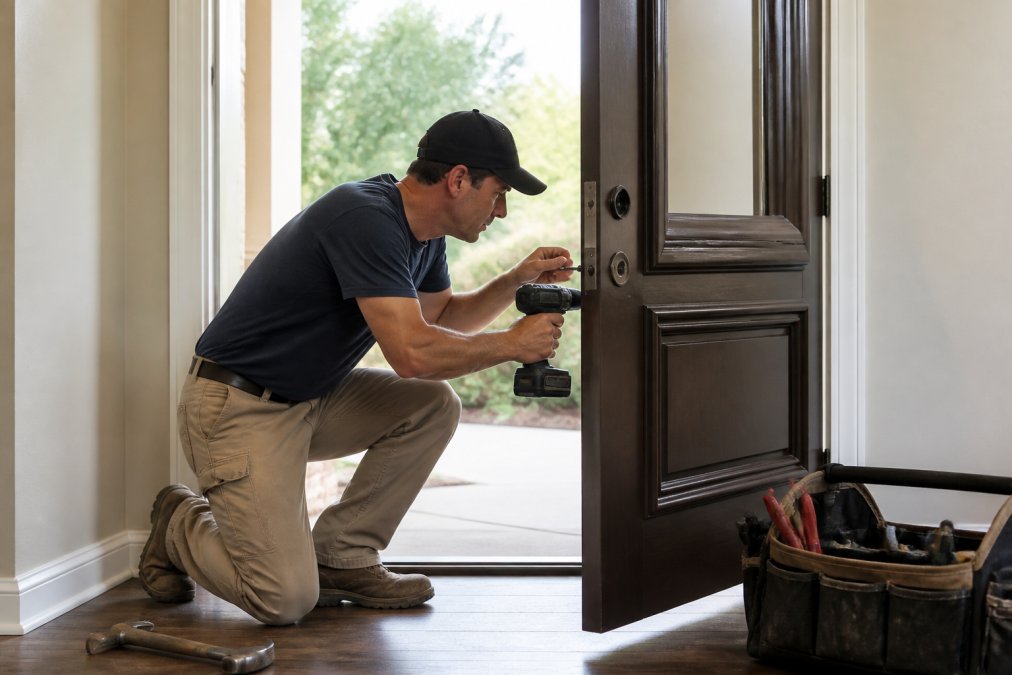
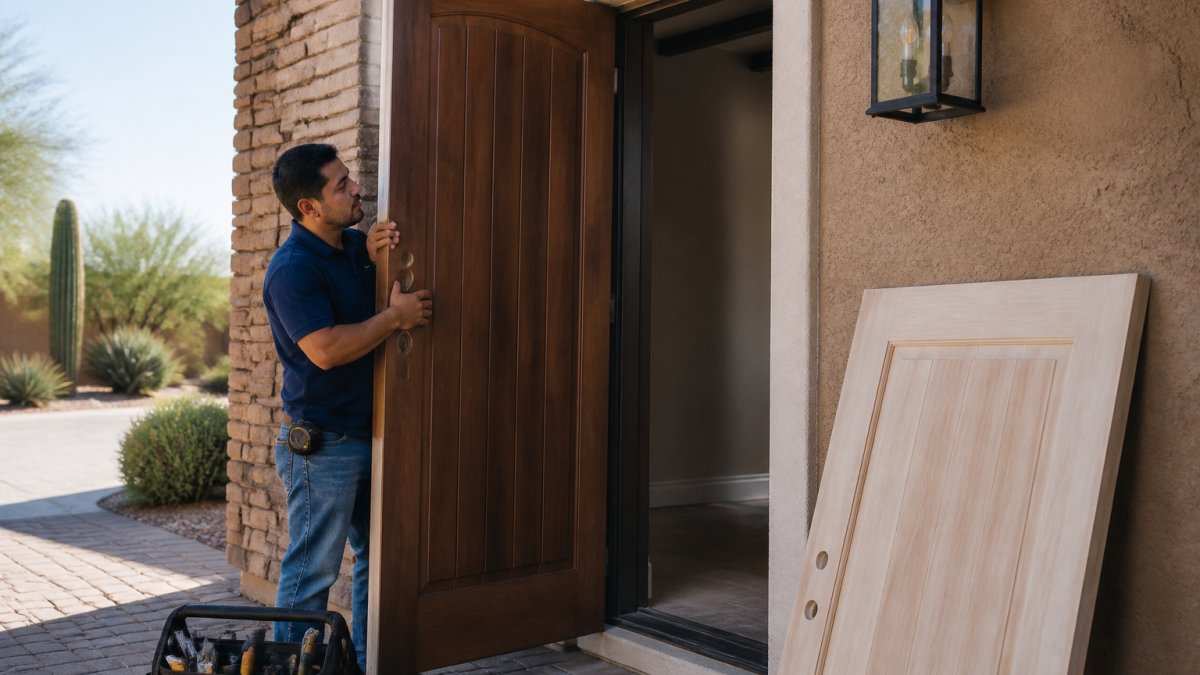
Door installation labor cost depends on complexity, not just hours. A prehung door in a square opening is fast work. A custom slab in an out-of-square opening takes patience, shimming, and adjustment, and that time is what you are paying for.
Crews generally charge for removal of the old door, setting and shimming the new one, hanging hardware, and cleanup. Structural changes or opening modification add labor on top.
Door Frame Replacement Cost When the Opening Needs Work
Door frame replacement cost is the line most often underestimated.
A door frame is the structure the door sits in. A door jamb is the vertical side of that frame.
In older Arizona homes, frames can shift with settling. Rebuilding the frame properly is not optional if you want the door to close cleanly and seal against dust and heat.
Using a Door Installation Cost Calculator Without Getting Misled
A door installation cost calculator is a rough estimating tool that multiplies a base rate by door type and size. It is useful for a ballpark and useless for a real budget, calculators cannot see your opening, wall condition, hardware choices, or local code requirements.
Use a calculator to sanity-check a quote, not to set your expectations. If a calculator says one thing and a local contractor says another, the contractor who has stood in your doorway is the better source.
New Construction vs. Replacement: How the Scope Changes
New construction and replacement are different jobs with different cost profiles. In new construction, the rough opening is built to the door, so the frame and opening are part of the build. In replacement, the opening already exists and may not match the new door, adding adjustment and sometimes modification.
| Project Type | Opening Condition | Typical Extra Work | Cost Impact |
|---|---|---|---|
| New construction | Built to spec | Frame set during build | Lower per-door labor |
| Replacement, square opening | Existing, true | Removal and rehang | Moderate |
| Replacement, out-of-square | Existing, settled | Frame rebuild, shimming | Higher |
| Replacement with size change | Existing, undersized | Opening modification, trim | Highest |
For replacement projects, expect the scope to grow if the old frame comes out damaged. That is normal, and a good contractor will flag it before starting.
Permits, HOA Rules, and Lead Times That Affect Your Total
Permits, HOA approval, and lead times are the cost factors for custom door installation in Arizona that homeowners forget until they delay a project. None is usually the largest line on a quote, but each can stop a job cold if handled in the wrong order. Resolve approvals before you order the door, because a custom door is built to your spec and cannot be returned to stock if the HOA rejects the style.
Permits and code: when an exterior door triggers them
Whether a permit is required depends on your jurisdiction and scope of work. A like-for-like replacement in an existing opening often does not require one, while changing the size of an exterior opening, adding a new opening, or altering structural framing typically does. Egress and safety-glazing rules can also apply: glass in or near a door may need safety glazing, and a sleeping-room egress door has minimum clear-opening dimensions.
HOA approval: the step that stalls projects
HOAs in the Phoenix metro often have rules about door color, style, glass, and hardware on street-facing entries. Approval usually runs through an architectural review committee and can take weeks, especially if the committee meets monthly. The cost impact is not the application fee, it is the schedule slip and the risk of ordering a non-compliant door. Submit the spec, finish color, and glass description before fabrication, and keep the approval in writing.
Lead times: the schedule that governs the project
Custom doors are built to order, so lead times matter more than most homeowners expect. A custom slab or special-order door takes longer than a stock size, and a delay stalls the whole project because the crew cannot hang a door that has not arrived. The sequence that keeps a project moving is: measure, design approval, HOA and permit approval where required, fabrication, delivery, then installation scheduling.
Frequently Asked Questions
What factors affect the cost of custom door installation?
The biggest drivers are door size and material, glass and finish options, labor for removal and disposal, and any frame or rough-opening work. Site conditions matter too. Out-of-square walls, uneven floors, and stucco or masonry openings in Arizona homes add labor hours. Hardware, weatherstripping, and trim also count. Because every quote combines these differently, ask your supplier to break out product, labor, and site work line by line so you can compare quotes fairly.
How much does labor cost for door installation?
Door installation labor cost varies with door type, opening condition, and whether the frame is being replaced. A straightforward interior slab swap takes far less time than an exterior entry door with new framing, flashing, and finish work. Rather than quoting a flat rate, ask your contractor how many hours they estimate and what the hourly rate covers. Get a written scope that lists removal, disposal, frame prep, and trim so labor charges are transparent.
Does a custom door cost more to install than a standard-size door?
Often yes, because custom dimensions may require modifying the rough opening, adjusting the frame, or ordering specialized hardware. A standard-size door that fits an existing opening needs less site work. If your opening is non-standard, expect the quote to include extra carpentry and possibly stucco or drywall repair. Confirm with your supplier whether the custom size fits your current opening or requires modification before you approve the order.
How can I get an accurate quote for custom door installation?
Start with exact measurements of the opening, photos of the existing door and frame, and a clear list of your material and finish choices. Share whether the project is new construction or a replacement. Ask for a quote that separates product cost, labor, frame work, disposal, and any permit or HOA requirements. A local supplier who can visit the site or review detailed photos will give a more reliable number than an online calculator alone.