 blog
5 MDF vs Solid Wood Moulding Tradeoffs That Matter
Last Updated: October 27, 2026
Quick Summary
MDF vs solid wood comes down to budget, finish, and room exposure. MDF is cheaper, smoother, and easier to paint, but it swells when wet and dents easily, while solid wood is tougher, more moisture tolerant, and easier to repair.
- MDF usually costs less per linear foot, which matters most on large jobs with many rooms.
- MDF cannot be stained convincingly, so stain-grade work calls for solid wood.
- MDF edges swell permanently when wet, so use solid wood in bathrooms, laundry rooms, and basements.
- Dented or chipped MDF often needs replacing, while solid wood can be sanded, filled, and refinished.
- MDF is not an exterior product and should never be used on covered patios or porch ceilings.
Table of Contents
- MDF vs. Solid Wood Moulding: The Overall Comparison
- How MDF and Solid Wood Are Made
- Cost, Value and Lifecycle Expense
- Paint-Grade Trim Materials: Finish, Sanding and Paintability
- Stain-Grade Wood Moulding and Species Choices
- MDF Moulding Moisture Resistance and Where Each Belongs by Room
- Choosing Your Moulding Before Your Next Order
- Frequently Asked Questions
MDF vs. Solid Wood Moulding: The Overall Comparison
Choosing between MDF vs solid wood moulding comes down to budget, finish, and where the trim will live. This same logic of material integrity often extends to larger interior projects, where understanding the structural nuances of wood versus particle board helps ensure that your furniture investments remain as durable as your baseboards.
The trade-offs in mdf vs solid wood are more practical than most online comparisons suggest. The five tradeoffs below are the ones that actually change the outcome of a project.
| Factor | MDF Moulding | Solid Wood Moulding |
|---|---|---|
| Upfront cost | Lower | Higher |
| Paint finish | Very smooth, no grain | Good, but grain can telegraph |
| Dent and chip resistance | Fair | Strong |
| Moisture tolerance | Poor in damp areas | Better, still needs sealing |
| Repairability | Limited | Easy to sand, fill, and refinish |
| Sharp detail and profiles | Excellent | Good, depends on species |
Pros of MDF: Low cost, flawless painted surface, holds crisp profiles. Cons of MDF: Swells with water, dents easily, hard to repair once damaged. Pros of solid wood: Durable, repairable, accepts stain well. Cons of solid wood: Higher price, can warp or cup if not acclimated, grain shows through paint.
How MDF and Solid Wood Are Made
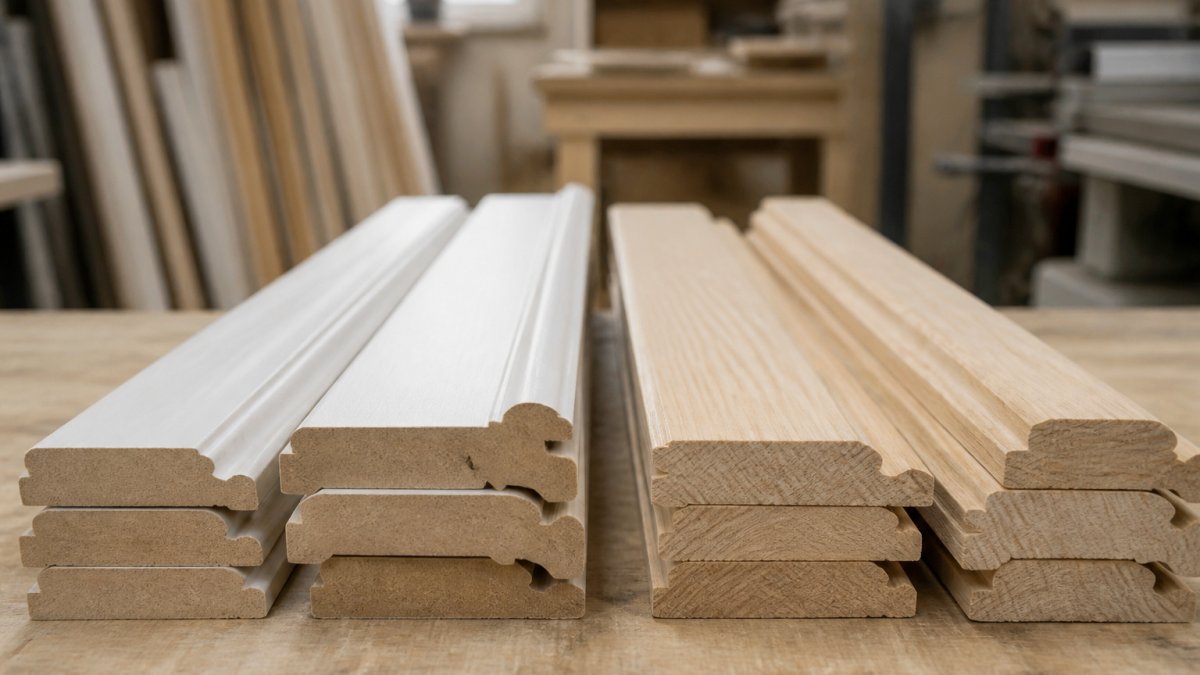
MDF is medium-density fiberboard, an engineered panel made from compressed wood fibers bonded with resin. To see how these panel materials are built, read What Are Flush Panel Doors Made Of?.
Solid wood moulding is cut from a single piece of lumber, often poplar, pine, or a finger-joint blend of short pieces glued into longer lengths. The natural grain and density give it strength, but also mean it expands and contracts with humidity.
Cost, Value and Lifecycle Expense
MDF usually costs less per linear foot than solid wood, and that gap matters on large jobs with many rooms.
Exact pricing depends on profile, length, quantity, and delivery, so check current pricing with Arizona Door Store before budgeting.
Where the lifecycle cost actually lands:
- Finishing labor. MDF needs light sanding, primer, and two coats of paint. Solid wood needs more sanding, knot and joint filling, and a stain-blocking primer to prevent tannin bleed. On a large job, the extra prep time on solid wood can narrow the upfront gap.
- Repair and replacement. A dented or chipped MDF baseboard often has to be replaced, because sanding and filling rarely blend invisibly on a painted MDF surface. Solid wood can usually be sanded, filled, and refinished. In a high-traffic hallway, one or two impact repairs can erase the upfront savings on MDF.
- Moisture events. A single water event, such as a leak or an overflowing fixture, can swell MDF edges beyond repair. Solid wood usually survives minor exposure and can be refinished. In bathrooms, laundry rooms, and basements, the replacement risk is part of the true cost.
- Repainting cycles. Both materials need repainting on a similar schedule in normal interior conditions. MDF's smooth surface may hold a slightly better sheen, but the paint cycle cost is roughly comparable.
- Waste and handling. MDF edges chip and crumble if handled roughly, and damaged edges are hard to repair, so waste can run higher on job sites with a lot of cutting and handling. Solid wood is more forgiving of minor handling damage.
Installation and tool requirements also affect the real cost:
- Cutting. MDF cuts cleanly with standard woodworking tools, but it produces fine dust that coats a room and requires good dust collection and respiratory protection. Solid wood produces heavier chips and sawdust that are easier to control.
- Fastening. Both materials fasten with finish nails or brads. MDF holds fasteners well in the face but can blow out at the edges, so predrilling near ends is common. Solid wood splits if not predrilled, especially in narrow profiles.
- Filling and caulking. MDF takes filler and caulk well, but sanding filled areas can fuzz the surface. Solid wood sands and fills cleanly, and the repair is more likely to disappear under paint.
- Handling. MDF is heavy and brittle at the edges; long lengths need support to avoid cracking. Solid wood is lighter per length in many profiles but can warp if not acclimated and stored flat.
A simple decision framework by homeowner priority:
| Priority | Lean toward | Reason |
|---|---|---|
| Lowest upfront cost on a large dry-area job | MDF | Lower material and finishing labor per linear foot |
| Smoothest painted finish with crisp profiles | MDF | No grain to telegraph; holds sharp contours |
| Stain-grade appearance | Solid wood | MDF cannot be stained convincingly |
| Moisture exposure (bath, kitchen, laundry, basement) | Solid wood or moisture-resistant product | MDF edges swell permanently when wet |
| High impact risk (hallways, stairways) | Solid wood | Repairable; MDF dents and chips are hard to fix |
| Long service life with repairability | Solid wood | Sand, fill, and refinish instead of replace |
| Fast, predictable paint-grade installation | MDF | Uniform surface, less prep, consistent results |
Before you order, confirm profiles, lengths, and quantities, and ask about delivery timing for your job site. Arizona Door Store's team can help you compare options for your specific project and explain what fits your budget.
Paint-Grade Trim Materials: Finish, Sanding and Paintability
For painted trim, MDF is the easy choice. It needs light sanding, a good primer, and two coats of paint to look finished. There is no grain to fill, so the result is smooth and consistent across long runs.
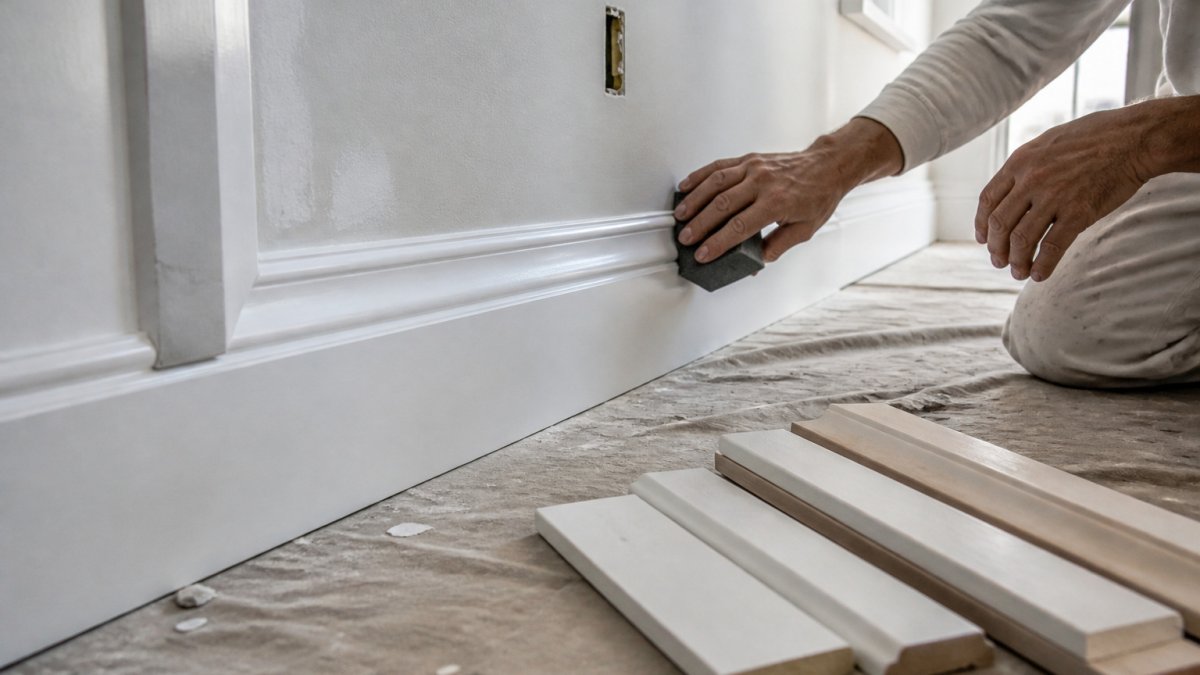
Solid wood can work well for paint too, especially finger-joint poplar. Sand thoroughly, prime with a stain-blocking primer, and fill any knots or joints before painting. For practical guidance on finishing wood surfaces for durability, see the related article.
Stain-Grade Wood Moulding and Species Choices
MDF cannot be stained convincingly, so stain-grade work calls for solid wood. Oak, maple, cherry, and walnut all take stain well, and each one looks different under the same finish. Choose the species based on the color and grain you want the room to show.
Test stain on an offcut from the same board before committing. For step-by-step refinishing guidance for wood surfaces, see the related article. Wood varies even within one species, and a sample on the actual piece is the only reliable preview.
MDF Moulding Moisture Resistance and Where Each Belongs by Room
MDF swells when it gets wet, and the edges are the first place to show damage. The mechanism matters: MDF is made of compressed wood fibers and resin, and when water reaches the exposed edge or an unpainted cut, the fibers absorb it, swell, and never fully return to their original thickness. Paint slows absorption but does not waterproof the core.
That difference is why the useful question is not "indoor or outdoor" but "which room, and what is the water and impact exposure in that room?" Here is how most practitioners map it:
| Room or area | Typical recommendation | Why |
|---|---|---|
| Bedrooms, living rooms, dining rooms, hallways | MDF is usually fine | Dry, climate-controlled, low splash risk; smooth paint finish is the priority |
| Home offices and closets | MDF is usually fine | Low moisture and low impact; cost savings add up on long runs |
| Kitchens (baseboards away from sink and dishwasher) | MDF can work, but seal cut edges and caulk the top and bottom | Splash and spill risk is localized; edge sealing is the deciding detail |
| Kitchens (toe kicks, sink base trim, dishwasher surround) | Solid wood or a moisture-resistant product | Repeated splash and leak exposure will swell MDF edges |
| Bathrooms | Solid wood or a moisture-resistant product | Steam, splash, and wet mopping are routine; MDF edges fail first |
| Laundry rooms and utility areas | Solid wood or a moisture-resistant product | Leaks and humidity spikes are common and hard to predict |
| Basements | Solid wood or a moisture-resistant product, and test for dampness first | Below-grade spaces often have higher ambient humidity and occasional seepage |
| Covered patios and exterior trim | Solid wood or a material rated for exterior exposure | MDF is not an exterior product; even covered areas see humidity swings |
| High-traffic hallways and stairways | Solid wood where impacts are likely; MDF acceptable on ceilings and upper walls | Dents and chips are the main failure mode, and MDF is harder to repair |
A few practical rules make the room-by-room plan work:
- Seal every cut edge. Paint the back and the cut ends of MDF before installation, and caulk the joint where the moulding meets the wall and the floor. Most MDF failures start at an unsealed edge.
- Keep MDF at least a few inches above a wet floor. On a bathroom or laundry wall, solid wood or a moisture-resistant product is the safer choice for baseboards.
- Use a moisture-resistant MDF where it is specified for damp interiors. It performs better than standard MDF but is not a substitute for solid wood in a shower area or a basement with active seepage.
- Check the substrate, not just the room. A wall that stays damp because of a plumbing leak or poor grading will damage any trim; fix the water source first.
- In dry climates, MDF is more forgiving. In low-humidity interiors, MDF holds up well in bedrooms, living areas, and hallways, and the cost savings are real on large jobs.
Choosing Your Moulding Before Your Next Order
Start by mapping each room to its demands: moisture exposure, impact risk, and whether the finish will be paint or stain. Once you know your choices, you can review the options and steps for ordering custom interior moulding.
Before you order, confirm profiles, lengths, and quantities, and ask about delivery timing for your job site. Arizona Door Store's team can help you compare options for your specific project and explain what fits your budget.
Frequently Asked Questions
Is MDF or solid wood better for moulding?
Neither is better in every case. MDF gives you a smooth, uniform surface that takes paint well and costs less per linear foot, which makes it a strong choice for painted interior trim in dry rooms. Solid wood handles impact, moisture swings and future refinishing better, and it is the usual choice for stained trim. Match the material to the finish you want and the room it goes in.
Which is more durable, MDF trim or solid wood trim?
Solid wood generally resists dents and chips better, and it can be sanded and repaired more easily when damaged. MDF is dense and stable, but its edges can crush or chip on impact and it does not hold a screw or nail as well near the ends. For high-traffic hallways, a solid or finger-joint profile often holds up longer. For low-traffic bedrooms, paint-grade MDF performs well for years.
Can MDF moulding be used in bathrooms?
MDF is not a good choice for areas that see direct water, such as tub surrounds or shower walls. Standard MDF swells when it absorbs moisture and can lose its profile. Moisture-resistant MDF is available and can work in some bathroom spots, but it still needs full sealing on all sides and edges. Solid wood or a primed, sealed material is usually the safer option for bathrooms and other damp spaces.
Does MDF trim cost less than solid wood?
Yes, MDF is typically less expensive than solid wood moulding of the same profile, which is one of its main advantages. Solid species such as poplar, pine or oak cost more, and the premium grows with the species and the grade. Check current prices or request a quote from Arizona Door Store before you budget a project.