ultimate-guide
What Are Flush Panel Doors Made Of?
Table of Contents
- What Flush Panel Doors Are (and Why the Materials Matter)
- Core Construction: The Structural Heart of Flush Panel Doors
- Hollow Core vs Solid Core Doors: Which Should You Choose?
- Flush Door Veneer Types: Surface Finishes and Finishing Options
- Flush Door Soundproofing Capabilities and Thermal Efficiency
- Flush Doors vs. Panel Doors: A Practical Comparison
- Weight, Hardware Compatibility, and Sustainability
- Conclusion
Last Updated: August 24, 2026
What Flush Panel Doors Are (and Why the Materials Matter)
Flush panel doors are interior or exterior doors with completely flat, uninterrupted face surfaces on both sides. Unlike traditional paneled doors with raised or recessed geometry, flush panel doors present a clean, continuous plane from edge to edge. The materials inside a flush door are not visible once installed, which is exactly why understanding them before you buy matters. A hollow core door and a solid core door look identical from the outside, but their performance differences are significant.
Below, this guide breaks down every layer of flush door construction: the internal frame, the face sheets, core types, veneer options, and how all of it affects real-world performance.
Core Construction: The Structural Heart of Flush Panel Doors
The structural integrity of any flush panel door begins with its internal framework. The frame underneath determines whether a door holds hardware reliably, resists racking under repeated use, and stays square over time.
Timber Frame, Stiles, and Rails
The outer skeleton of a flush door consists of stiles (vertical members running the full height) and rails (horizontal members at top and bottom). These are typically made from solid timber or engineered wood composites. A common mistake is underestimating how much stile width matters for hardware installation. Narrow stiles can limit options for mortise locks and heavy-duty hinges. According to Wood Products Council's guidance on engineered wood framing, engineered timber components offer improved dimensional stability compared to solid sawn lumber in moisture-prone applications.
Face Sheets: Hardboard, MDF, and Plywood Skins
The face sheets are the flat panels bonded to each side of the internal frame. Three materials dominate this layer:
- Hardboard: Dense, smooth panels made from compressed wood fibers. Common in budget-grade hollow core doors, hardboard takes paint well but is vulnerable to denting and moisture absorption if not sealed.
- MDF (Medium-Density Fiberboard): A manufactured composite producing an exceptionally smooth surface, ideal for painted finishes. MDF is heavier than hardboard and more resistant to surface irregularities, but sensitive to moisture at edges.
- Plywood: Cross-laminated wood panels offering better structural strength and screw-holding capacity. Plywood skins are used in higher-grade doors where dimensional stability and impact resistance are priorities.
The face sheet material directly affects finishing options, paint adhesion, and how the door responds to humidity cycling over time.
Hollow Core vs Solid Core Doors: Which Should You Choose?
The core is the single biggest performance variable in flush door construction. Hollow core and solid core doors share the same external appearance but deliver fundamentally different results in use.
Hollow core doors use a lightweight internal structure, most commonly cardboard honeycomb or a grid of wood-fiber components. This keeps weight low, typically under 30 pounds for a standard 80-inch door, and manufacturing costs down. They are the standard choice for interior closet doors, pantry doors, and low-traffic bedroom doors where sound isolation and security are not priorities.

Solid core doors fill the interior with particleboard, MDF, or composite wood-fiber material bonded under pressure. The result is a door weighing 60 to 80 pounds or more for a standard size. That weight translates directly into better sound attenuation, a more substantial feel when closing, and significantly better resistance to forced entry. Solid core doors also resist warping more effectively because the dense fill material limits the door's ability to respond to seasonal moisture changes.
| Core Type | Weight | Sound Performance | Best Application | Hardware Compatibility |
|---|---|---|---|---|
| Hollow core (honeycomb) | Light | Minimal attenuation | Closets, low-traffic interiors | Standard residential |
| Hollow core (wood fiber grid) | Light-medium | Slightly better | Bedroom, bathroom | Standard residential |
| Solid core (particleboard) | Heavy | Good attenuation | Home office, main bedroom | Reinforced hinges recommended |
| Solid core (MDF composite) | Heaviest | Best attenuation | Media rooms, exterior applications | Heavy-duty hardware required |
Flush Door Veneer Types: Surface Finishes and Finishing Options
The surface of a flush panel door is where aesthetics and durability intersect. Most flush doors ship with one of four finishing options.
Wood veneer is a thin slice of real timber bonded to the face sheet using adhesive under heat and pressure. Hand-selected veneers from species like oak, maple, walnut, or cherry give flush doors a natural wood grain appearance that paint cannot replicate. Veneer doors require finishing on site with stain, sealer, and topcoat, which adds labor but allows complete control over appearance.
Laminated skin (high-pressure laminate or thermofused laminate) bonds a decorative paper or plastic layer directly to the face sheet. Laminated flush doors arrive factory-finished, require no on-site painting, and resist surface scratches better than raw veneer. The trade-off is that laminate cannot be refinished if damaged.
Primed MDF surface is the most common option for painted interiors. The MDF face sheet arrives with factory primer, ready for topcoat application. This produces the smoothest painted finish because MDF has no grain to telegraph through paint.
Fiberglass skin appears on exterior flush doors where weather resistance is the priority. Fiberglass does not absorb moisture, will not rot, and can be textured to mimic wood grain. According to Department of Energy guidance on exterior door materials, fiberglass exterior doors offer better thermal efficiency than steel in most residential applications.

Flush Door Soundproofing Capabilities and Thermal Efficiency
Sound transmission through a door is measured using the Sound Transmission Class (STC) rating. Hollow core doors typically achieve STC ratings in the low-to-mid 20s, meaning normal speech is clearly audible through them. Solid core doors with dense particleboard or MDF fill generally reach STC ratings in the low-to-mid 30s, which reduces speech intelligibility significantly. For most residential applications, a solid core flush door provides meaningful improvement over hollow core for home offices, bedrooms adjacent to common areas, or media rooms. Door seals, thresholds, and frame gaps contribute as much to acoustic performance as the door itself.
Thermal efficiency follows similar logic. A hollow core door provides almost no insulation value. A solid core door improves slightly on that baseline, but neither type approaches the thermal performance of exterior doors with foam-injected cores such as polyurethane or polystyrene fill. The ENERGY STAR program's door certification criteria provides a useful benchmark for evaluating exterior door thermal performance.
Flush Doors vs. Panel Doors: A Practical Comparison
The comparison between flush panel doors and traditional panel doors comes down to aesthetics, maintenance, and application fit.
Panel doors feature raised or recessed rectangular sections created by stiles, rails, and mullions. They dominate traditional and transitional residential architecture. Flush doors present a single unbroken surface and align naturally with modern, contemporary, and minimalist design languages.
From a maintenance standpoint, flush doors are easier to clean and paint. There are no inside corners or shadow lines to trap dust or require careful brush work. For painted interiors, this is a genuine practical advantage. What most guides miss is the hardware implication: flush doors offer more flexibility in hardware positioning because the face is continuous, but they require careful attention to whether the internal frame extends to the hardware location.
| Feature | Flush Panel Doors | Traditional Panel Doors |
|---|---|---|
| Surface profile | Flat, uninterrupted | Raised or recessed panels |
| Design compatibility | Modern, contemporary | Traditional, transitional |
| Painting ease | High | Moderate (inside corners) |
| Hardware flexibility | High (continuous face) | Moderate (defined by stile/rail) |
| Sound performance | Depends on core | Depends on core |
| Cost range | Varies by core and finish | Varies by profile complexity |
Weight, Hardware Compatibility, and Sustainability
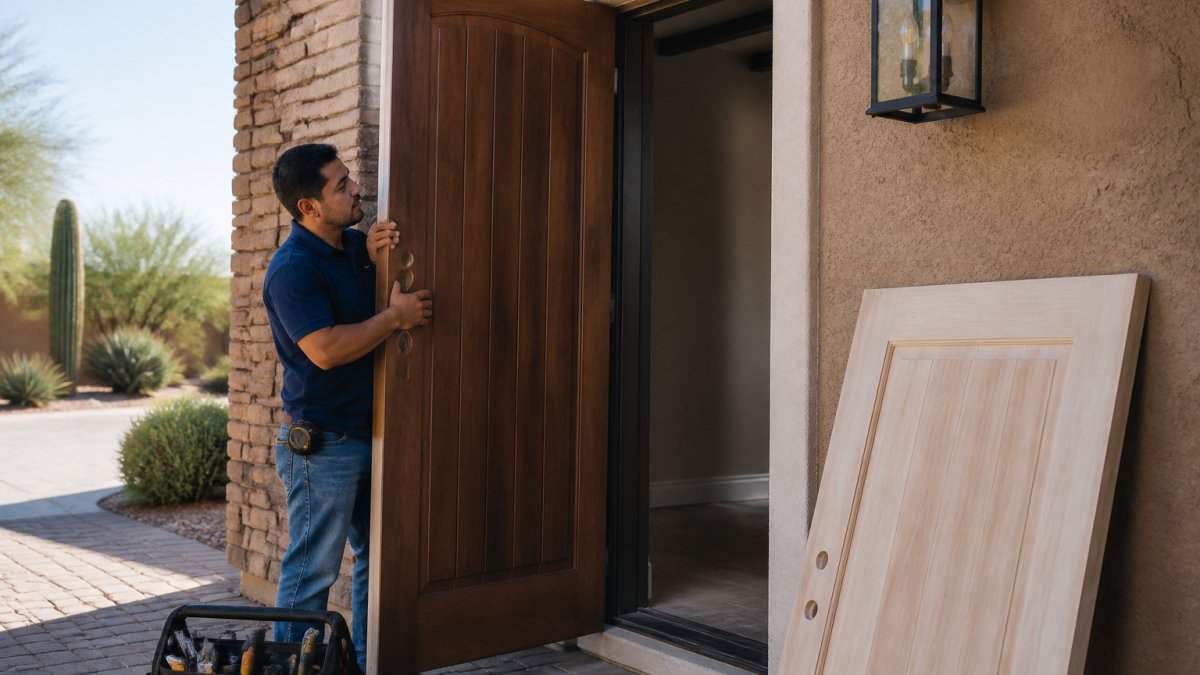
Weight is the practical detail that installation teams feel most directly. A hollow core flush door in a standard 32x80 inch size is light enough for one person to hang. A solid core door of the same dimensions may require two people and a door jack, particularly on upper floors or in tight hallways.
Hardware compatibility follows from weight. Heavy solid core doors exert more stress on hinges over time. Standard two-hinge installations are adequate for hollow core doors. Solid core doors benefit from three hinges, and very heavy custom pivot doors may require specialized bearing hardware.
On sustainability, flush door construction has improved as manufacturers shift toward certified wood sources and low-emission adhesives. Many MDF and particleboard cores are now produced using wood-fiber components from certified forestry operations. The Forest Stewardship Council certification standards provides a recognized framework for verifying that wood products come from responsibly managed forests. Laminated skin doors eliminate the need for site-applied finishes, which reduces volatile organic compound (VOC) emissions during construction. For projects targeting indoor air quality certifications, factory-finished flush doors with low-VOC adhesive bonding are worth specifying.
DIY installation of a flush door is achievable for hollow core interior doors in standard sizes with plumb, square frames. Pre-hung units simplify the process considerably. Solid core doors in non-standard openings, or any exterior door installation, are better handled by an experienced installer.
Choosing the right flush panel door comes down to matching core type, face sheet material, and surface finish to the specific demands of each opening. Hollow core works for low-traffic interiors; solid core is the right call for bedrooms, offices, and any space where sound or security matters. The Arizona Door Store team works through exactly these decisions with contractors and homeowners every day, with expert consultants who understand the difference between a door that looks right and one that performs right over the long term. Visit one of our design centers in Scottsdale or Phoenix, or contact us directly to get reliable guidance and fast local delivery for your next project.
Frequently Asked Questions
What is the difference between a hollow core and solid core flush door?
Hollow core flush doors use a lightweight internal structure, typically a cardboard honeycomb or wood-fiber grid, sandwiched between face sheets. They weigh significantly less and cost less, making them common for interior bedroom and closet doors. Solid core doors are filled with particleboard, MDF, or a wood composite throughout, giving them better sound insulation, greater warp resistance, and a more substantial feel. Solid core doors are a common choice for home offices, bathrooms, and any space where privacy or noise reduction matters.
What materials are used for the face veneer of flush doors?
Flush door face veneers fall into three main categories: natural wood veneer (such as oak, maple, or walnut), which is hand-selected and sliced thin from real timber; MDF or hardboard skins, which provide a smooth, paint-ready flat surface; and high-pressure laminate or fiberglass skins, which offer moisture resistance and durability for high-traffic or exterior applications. The veneer type directly affects how the door can be finished, stained, painted, or left with a natural wood appearance.
Do flush panel doors provide good soundproofing?
Flush panel doors vary considerably in their soundproofing capabilities depending on core type. Hollow core doors offer minimal sound insulation and are not suitable for spaces requiring acoustic privacy. Solid core doors filled with particleboard or MDF perform noticeably better, reducing sound transmission between rooms. For improved flush door soundproofing, consider doors with a higher STC (Sound Transmission Class) rating. Proper installation, including door seals and threshold gaskets, also plays a major role in overall acoustic performance.
Can flush panel doors be painted or stained?
Yes, though the right finish depends on the face material. Doors with real wood veneer or MDF skins accept both paint and stain well. Natural wood veneer takes stain most effectively, allowing the grain to show through. MDF and hardboard skins are ideal for painted finishes because their flat surface eliminates grain texture. Laminated skins typically come pre-finished and are not designed for staining. Always check the manufacturer's finishing guidelines before applying any coating to preserve the door's structural integrity and warranty.
This article was written using GrandRanker