 Comparison
7 Door Seals That Close Uneven Gaps Better Than Sweeps Alone
Quick Summary
The best door seal for uneven gaps depends on the cause: a flexible V-seal or compression strip suits a door that is slightly out of plumb, while a flexible or brush sweep handles uneven floors. Repair hinges and alignment first, then measure the widest and narrowest gap on each edge to match the seal to the gap.
- Diagnose the cause first, since a warped slab or racked frame needs repair before sealing.
- Measure at five points on every edge: each corner and the center.
- Match the seal's maximum rated gap to your widest measurement.
- Measure the bottom gap with the door closed and latched, not open.
- Test the fit with a paper test and a light check for air leaks.
Table of Contents
- Why Uneven Gaps Let Air and Drafts Through
- Measure the Gap Before You Choose a Seal
- Weatherstripping for Uneven Door Gaps: V-Seal, Foam and Compression Options
- Door Sweep for Uneven Floor: Brush, Flexible and Automatic Bottoms
- Extra Thick Weather Stripping for Exterior Doors and Large Gaps
- Side-by-Side: Best Door Seals for Uneven Gaps at a Glance
- Pick Your Door Seal and Get a Quote from Arizona Door Store
- Frequently Asked Questions
Why Uneven Gaps Let Air and Drafts Through
An uneven gap is a symptom, and the seal you buy depends on which underlying problem is producing it. Before shopping, spend five minutes diagnosing the cause, because a seal that covers a gap caused by a warped slab will fail again within a season, while the same seal may solve a gap caused by a slightly out-of-square frame.
The most common cause is a door that has settled or gone out of plumb. Check by opening the door halfway and looking at the gap between the door edge and the frame at the top and bottom of the latch side. If the top gap is wide and the bottom gap is tight, or the reverse, the door is racked in its opening.
A second cause is a warped or bowed door slab. Hold a straightedge or a level against the face of the door, vertically and diagonally. A slab that bows inward at the middle will leave a gap at the center of the latch side even when the corners are tight.
A third cause is an out-of-square frame. Measure the opening diagonally from corner to corner; if the two diagonal measurements differ by more than about 1/4 inch, the frame is out of square. This is common in older homes and after foundation movement. Seals can compensate for a small amount of out-of-square, but a frame that is visibly racked will need carpentry before weatherstripping will hold.
A fourth cause is a floor that is not level under the threshold. Set a level or a straightedge across the threshold and check for a gap under it at either end. Our guide to fixing gaps under exterior doors walks through each step of closing that bottom gap.
Watch out: if the door latches only when you lift or push it, the problem is alignment, not sealing, and adding a thick seal will make latching harder rather than stopping the draft.
Once you know the cause, the seal choice becomes obvious. A door that is slightly out of plumb or has a mildly uneven floor is a good candidate for a flexible or compressible seal. A door with a warped slab, a racked frame, or stripped hinges needs repair first; sealing it is a temporary patch.
Measure the Gap Before You Choose a Seal
A single measurement at the middle of the door tells you almost nothing about an uneven gap. The number that matters is the spread between the widest and narrowest points, because a seal has to bridge the widest point while still letting the door latch at the narrowest one. Measure at five points on every edge: each corner and the center. On the hinge side and latch side, measure at the top, middle, and bottom.
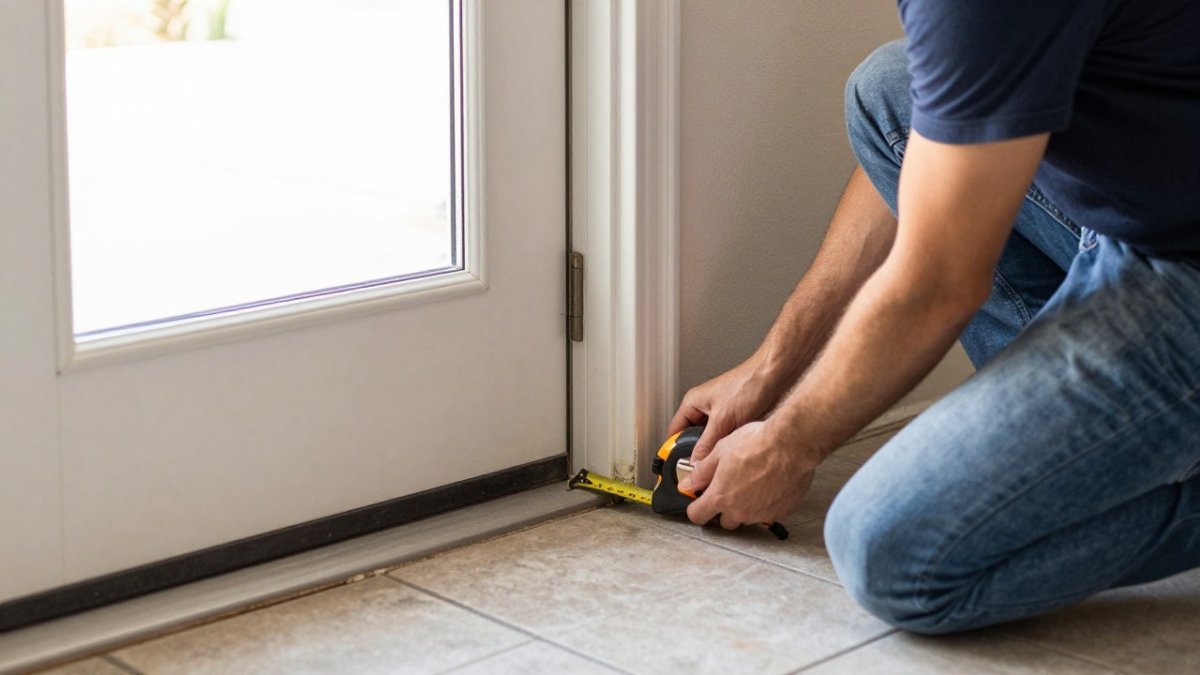
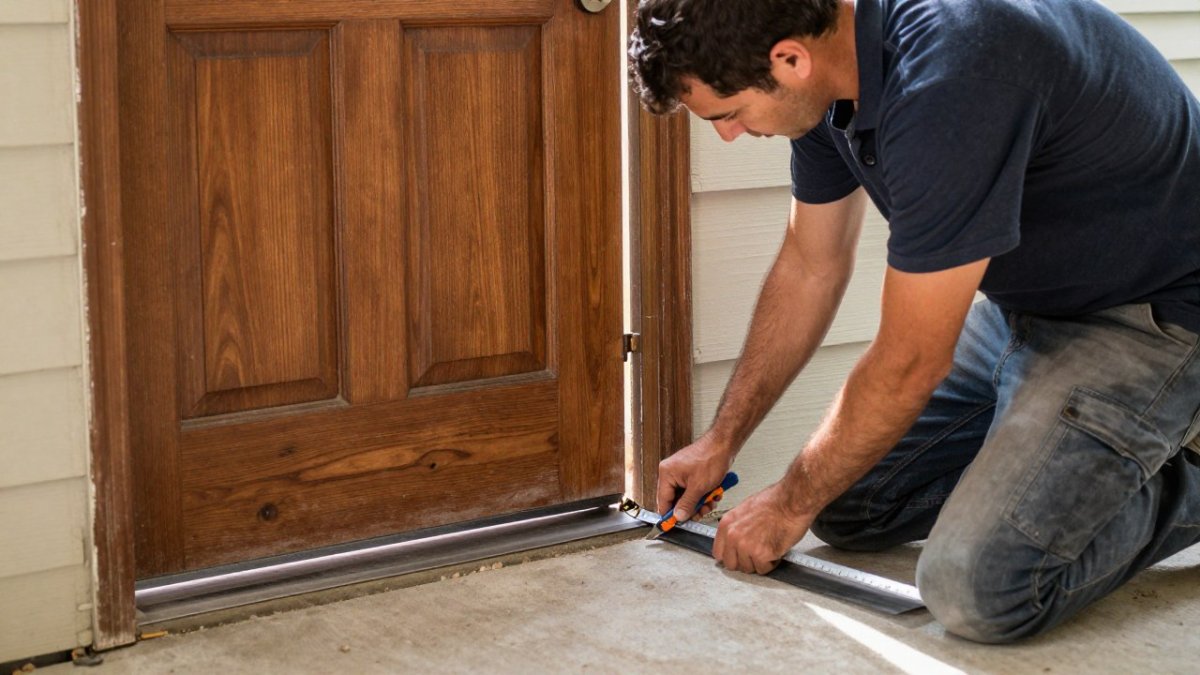
Use a feeler gauge for gaps under about 1/2 inch; it gives a cleaner reading than a tape measure and won't flex the door. If your floor or frame looks out of level, learn how to correct it before sealing. For larger bottom gaps, slide a tape measure or a ruler flat on the floor and read to the bottom edge of the door.
Now convert those numbers into a buying decision. Every seal is sold with a stated gap range, and the usable range is narrower than the packaging suggests because the seal needs compression to seal and clearance to let the door close. When the same out-of-square problem leaves uneven openings at a window, sealing gaps around windows calls for the same careful attention to the widest and narrowest points.
For the bottom, measure the gap with the door closed and latched, not open. The door moves as it swings, and a sweep that clears the floor when the door is open can drag or leave a gap when it is closed. Check the gap at the hinge side, the latch side, and the center, and note any point where the floor rises or dips by more than 1/8 inch across the door's width.
Watch out: measuring a gap on a hot afternoon and buying a seal for that number can backfire on an exterior door, because steel and wood slabs expand and the frame moves with temperature and humidity; leave a small margin and recheck the fit in cooler weather.
Finally, verify the repair after installation with a simple air-leak test. Close the door on a piece of paper at several points along each edge; if the paper slides out with no drag, the seal is not making contact there. At night, have someone shine a light along the outside edges while you look for leaks from inside.
Weatherstripping for Uneven Door Gaps: V-Seal, Foam and Compression Options
Weatherstripping is a common answer to uneven gaps around the sides and top of a door. The right type depends on how much the gap varies and how often the door opens.
V-seal weatherstripping for doors that shift
V-seal, sometimes called V-strip, is a flexible metal-backed or vinyl strip shaped like a V. It mounts to the door frame, and the open end presses against the door when closed. Because the V flexes, it handles doors that shift slightly over time.
V-seal works best on doors that open and close often and sit fairly square in the frame. It does not fill large voids well, so check the measured gap first. Install it on the stop, not the door face, so the seal meets the door cleanly.
Watch out: V-seal that is too stiff can make a door hard to latch and may wear faster on a door that opens daily.
Foam seals for small, irregular spaces
Foam weatherstripping compresses into irregular gaps and works well for small openings, typically under about 1/4 inch. It is inexpensive and easy to cut to length. Self-adhesive foam is the simplest to install, though adhesive can fail in Arizona heat if the surface is not clean and dry before application.
Foam is a good choice for interior doors and light-use entries.
Pricing varies by brand, length, and profile, so check current prices with Arizona Door Store before you buy.
Door Sweep for Uneven Floor: Brush, Flexible and Automatic Bottoms
Weatherstripping handles the sides and top. The bottom of the door needs a different approach, especially when the floor is uneven.
A brush-style sweep uses bristles that drag across the floor and close small variations. It suits interior doors and exterior doors on tile or wood, and it tolerates minor floor dips well. Brush sweeps are not ideal for thresholds with large steps.
A flexible rubber or vinyl sweep bends to follow the floor contour. It seals better than a rigid sweep on uneven surfaces, though it can wear on rough concrete.
Automatic door bottoms drop a seal when the door closes and lift it when the door opens. Check whether the seal can be adjusted before buying.
Extra Thick Weather Stripping for Exterior Doors and Large Gaps
Exterior doors can face intense sun, heat cycling, and wind-driven dust. For large gaps, a heavier-duty seal may be worth considering.
Extra thick weatherstripping uses a denser profile that compresses to fill larger voids. Ask about material options for exterior use when you request a quote. For sealing against dust and heat specifically, see how to seal a door against dust and heat.
Compression seals can suit doors that are heavy or have an uneven frame. Make sure the door still closes and latches easily after installation.
For very large gaps, the underlying frame or door may need adjustment. A seal can cover a gap but cannot fix a door that no longer hangs square.
Side-by-Side: Best Door Seals for Uneven Gaps at a Glance
The table below summarizes the main options by gap type and use. Use it as a starting point, then confirm the product's stated gap capacity before buying.
| Seal Type | Best For | Gap Range | Durability | Install Difficulty |
|---|---|---|---|---|
| V-seal (V-strip) | Doors that open often, shifting doors | Small to moderate | High | Moderate |
| Foam weatherstrip | Small, irregular spaces, interior doors | Under about 1/4 inch | Low to moderate | Easy |
| Flexible door sweep | Uneven floors, bottom gaps | Varies with floor | Moderate | Easy to moderate |
| Brush-style sweep | Tile and wood floors, interior doors | Small variations | Moderate | Easy |
| Automatic door bottom | Level floors, quiet operation | Fixed drop | Moderate to high | Moderate |
| Extra thick compression seal | Exterior doors, large gaps | Up to about 1/2 inch | High | Moderate |
Pricing depends on quantity, dates, and delivery. For current prices or a quote, contact Arizona Door Store. Before ordering, measure your door accurately for replacement.
Pick Your Door Seal and Get a Quote from Arizona Door Store
Start with the measurement. Record the widest gap on each side, the top, and the bottom. Then match the gap to a seal type: foam or light V-seal for small gaps, extra thick compression for large exterior gaps, and a flexible sweep for uneven floors.
Install the seal on a clean, dry surface, and test the door by closing it and checking for light and airflow. Adjust or replace any seal that prevents the latch from engaging.
If you need help choosing the right seal, or you want to match a door replacement to your opening, contact Arizona Door Store for a quote. Our team can help you work through the measurements and options for your project. Pricing depends on quantity, dates, and delivery, so request a quote for the exact products you need.
Frequently Asked Questions
How do I seal a door with uneven gaps?
Start by measuring the gap at several points, since a door with uneven gaps often has a wider space at one side or corner. Use a compressible seal such as V-seal or foam weatherstripping along the sides and top, which can flex to follow the variation. For the bottom, pick a door sweep with a flexible or brush-style strip that can follow an uneven floor. Install one product at a time, test the door closing, and check for light or air at the edges. If the door sticks or doesn't close squarely, adjust the hinges or strike plate before adding seals, because a misaligned door will compress one side of a seal far more than the other.
Is rubber or silicone better for door seals?
Both work well for most residential doors, and the right choice depends on the gap size and how often the door opens. Rubber EPDM is durable, holds up to weather and temperature swings, and is common for exterior doors. Silicone stays flexible in heat and cold and is easy to apply as a self-adhesive strip, but it generally suits smaller gaps. For larger uneven gaps, a foam or rubber compression seal often performs better than a thin silicone strip. Check the gap capacity listed on each product before you buy.
What type of door sweep is best for uneven floors?
A brush-style or flexible door sweep usually handles uneven floors best, because the bristles or vinyl leaf can bend to follow dips and high spots. Automatic door bottoms drop the seal when the door closes, which works well on level floors but can catch on tile, thick carpet, or a floor that slopes. Adjustable sweeps let you set the height, so you can match the floor more precisely. Measure the highest and lowest points under the door before buying so you know how much range you need.
How do you seal a large gap under an exterior door?
For a large gap under an exterior door, combine a heavy-duty door sweep with thick compression weatherstripping on the sides and top. If the gap is more than about 1/2 inch or the threshold is damaged, a new threshold or door bottom may be a better long-term fix than sealing alone. Pricing depends on door size, material, and quantity, so contact Arizona Door Store for a current quote before you buy.