 ultimate-guide
How to Choose Kiln-Dried Lumber for Cabinetry
Last Updated: October 29, 2026
Quick Summary
Kiln dried lumber is wood dried in a temperature- and humidity-controlled chamber until its moisture content suits interior use, which keeps cabinets from moving after installation. Cabinet lumber should read roughly 6% to 8% moisture content for most interior installations, with 6% to 12% as the general working window depending on climate and the home's conditioning.
- Air-dried boards typically carry too much moisture for interior joinery and arrive with more case hardening and surface checking.
- Push meter pins to about one-quarter of the board's thickness and take at least three readings per board.
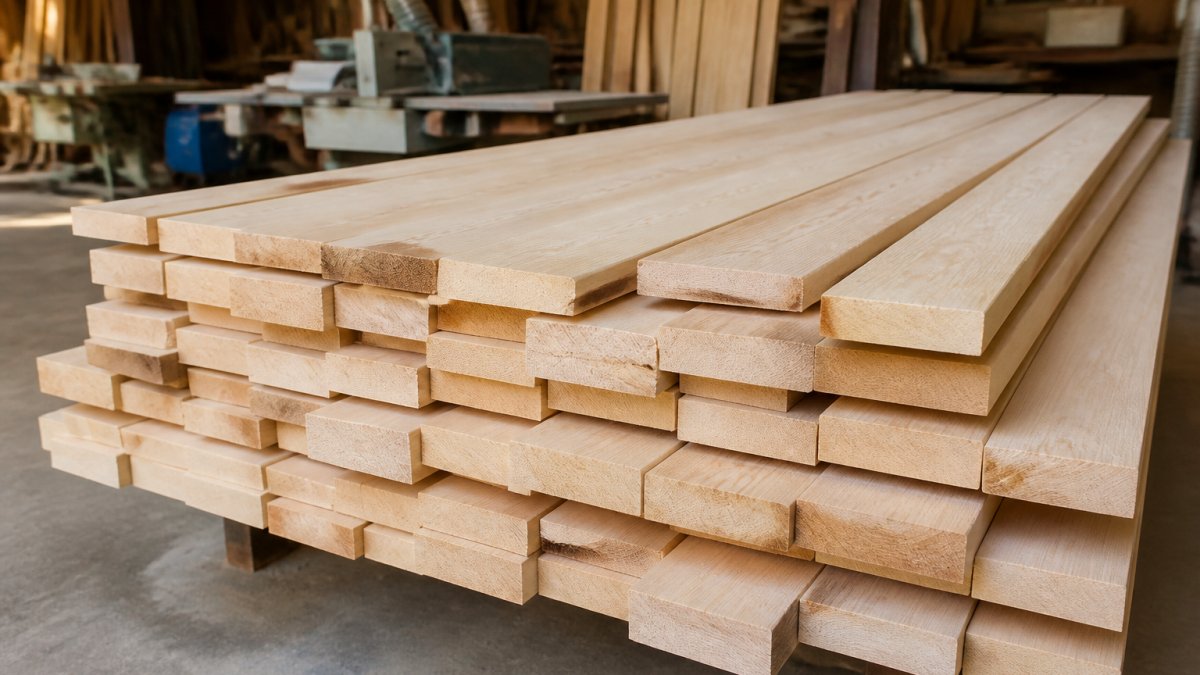
- Stack boards with stickers between layers, keep them off a concrete floor, and check with a meter every few days.
- Flat center panels must float in their grooves, often with around 1/16 inch per side for a typical interior door.
- Heat in the kiln kills many wood-boring insects and their larvae, which is why kiln-dried stock is standard for interior millwork.
Table of Contents
- Why Kiln-Dried Lumber Matters for Cabinetry
- Kiln-Dried vs. Air-Dried Lumber for Cabinets
- The Best Moisture Content for Cabinet Lumber
- How to Acclimate Lumber Before Cabinetmaking
- Dimensional Stability: Less Warping, Twisting, and Cracking
- Pest, Mold, and Decay Resistance in Finished Cabinets
- The Best Wood Species for Cabinets
- Sourcing Kiln-Dried Lumber for Your Next Cabinet Project
- Frequently Asked Questions
Why Kiln-Dried Lumber Matters for Cabinetry
Kiln dried lumber is wood dried in a temperature- and humidity-controlled chamber until its moisture content suits interior use.
A cabinet is a moisture equilibrium device: every board constantly trades water vapor with the room around it. If wood enters your shop at a moisture level far from where it will live, the cabinet moves after installation. Kiln drying gets that number under control before the first cut.
How the Kiln Drying Process Works
A kiln drying schedule is a staged sequence, not a single bake. Green lumber starts with high humidity and moderate heat; as moisture leaves, the operator raises temperature and lowers humidity in steps. Steam injection can re-soften the surface if the outer layers dry faster than the core.
Drying time depends on species, thickness, and starting moisture. A reputable mill tracks each charge rather than running one generic program.
Controlled Heat, Airflow, and Humidity in the Kiln
Three variables do the work, and each can go wrong independently:
- Temperature drives how fast water moves through the cell walls. Too high, too early, and the surface seals over while the core stays wet.
- Airflow must be uniform across the stack. Dead spots in a poor sticker pattern leave boards drying at different rates in the same charge.
- Humidity controls the gradient between wood and air. Operators hold it high early, then drop it in controlled steps.
A mill that only monitors temperature is guessing. Ask for the schedule and the final moisture readings on the charge you are buying.
Kiln-Dried vs. Air-Dried Lumber for Cabinets
Air-dried lumber is stacked outdoors or in an open shed and left to reach equilibrium with local air, which in most climates settles well above the range cabinets need from kiln dried lumber.
Air drying is slower, gentler on some species, and cheaper. For timber framing, outdoor furniture, or stock you plan to machine months later, it can be sensible.
The practical trade-off:
| Factor | Kiln-Dried | Air-Dried |
|---|---|---|
| Typical moisture content | Specified target, verified by meter | Settles near local outdoor humidity |
| Drying speed | Weeks, on a controlled schedule | Months to years |
| Defect control | Managed through temperature and humidity steps | Dependent on weather and stacking |
| Insect and fungal risk | Substantially reduced by heat | Higher, especially in humid seasons |
| Best use | Cabinets, interior furniture, millwork | Framing, outdoor work, long-term stock |
One caveat worth stating plainly: kiln drying is not a guarantee. A poorly run kiln produces worse stock than good air drying.
The Best Moisture Content for Cabinet Lumber
Cabinet lumber should read roughly 6% to 8% moisture content for most interior installations, with 6% to 12% as the general working window depending on climate and the home's conditioning. In dry, conditioned interiors, aim toward the lower end.
This is where most cabinet failures begin. A board machined at 12% and installed in a home that settles near 7% shrinks across its width; a raised panel door built tight at 6% in a humid room can bind as it picks up moisture.
How to Measure Moisture with a Meter
Use a pin-type moisture meter on multiple boards, not one. Push the pins to about one-quarter of the board's thickness and take at least three readings per board: near each end and in the middle.
A common mistake is trusting a single reading from the top board of a stack. Moisture varies board to board and end to end. Record your readings, and reject or re-sticker any board well outside the range of the rest.
How to Acclimate Lumber Before Cabinetmaking
Acclimation means letting lumber sit where it will be machined and, ideally, installed, until it stops changing.
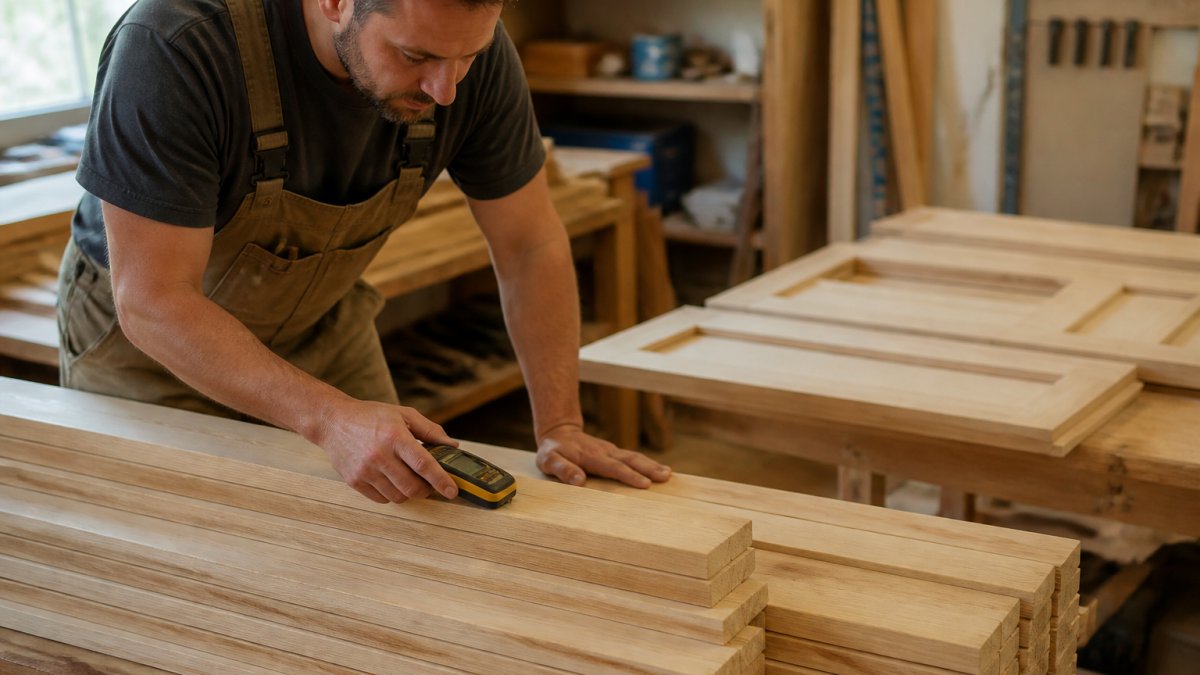
Check with a meter every few days. Proper moisture management remains just as critical when selecting wood slabs for larger furniture projects where structural stability is paramount.
Dimensional Stability: Less Warping, Twisting, and Cracking
Dimensional stability is the wood's resistance to changing shape as moisture shifts. Properly dried lumber moves far less in service, and predictably. But "stable" is not a single property, a board that passes a meter check can still ruin a door if its grain orientation, thickness, or panel construction fights the movement that remains.
How Wood Moves, and Why Cabinet Parts React Differently
Wood shrinks and swells almost entirely across the grain, tangentially (parallel to the growth rings) and radially (perpendicular to them), and barely at all along the length. A flat-sawn board may move roughly twice as much tangentially as radially, which is why flat-sawn stock cups and twists more than quarter-sawn or rift-sawn stock of the same species. That is anatomy, not a drying defect; proper drying brings the board to a moisture content where the remaining movement is small and predictable.
Translate that to cabinet parts:
- Door stiles and rails are long-grain components. They move very little in length, which is why a well-built frame stays square. The risk is not length change but bow or twist if the stock was dried with residual stress or machined before it reached equilibrium.
- Door and drawer fronts are wide panels. A 12-inch-wide flat-sawn maple door front can move noticeably across its width with seasonal humidity swings even when dried correctly. That is normal; the goal is to keep the movement within the clearance the hinges and reveals allow.
- Flat center panels in frame-and-panel doors must float in their grooves. If a panel is glued or pinned tight across its width, seasonal swelling has nowhere to go and the panel splits or the frame bows. The panel should be sized with a small gap, often around 1/16 inch per side for a typical interior door, adjusted for panel width and local humidity swing, so it can expand without loading the frame.
Warping, Twisting, Cupping, and Splitting: Tracing the Cause
These defects usually trace back to one of three causes: wood dried to the wrong target, wood dried with excessive residual stress (case hardening), or wood machined before it finished moving. Kiln drying addresses the first two when the schedule is run correctly; acclimation addresses the third.
A useful diagnostic habit: when a finished door cups, note whether the cup follows the growth rings (a grain-orientation and moisture-gradient issue) or appears as a uniform bow (more often a machining or stress issue).
Pest, Mold, and Decay Resistance in Finished Cabinets
Heat in the kiln kills many wood-boring insects and their larvae, one reason kiln-dried stock is standard for interior millwork. Lower moisture content also removes the conditions mold and fungi need.
None of this makes cabinets immune. A leak under a sink or a poorly ventilated cabinet against an exterior wall can raise moisture enough to support fungal growth regardless of how the lumber was dried.
The Best Wood Species for Cabinets
Species choice and drying quality are separate decisions, and both matter. Readers designing cabinets for tight spaces can find layout ideas in our guide to designing custom closet shelving for small spaces. For cabinetry, the useful question is not "which species is best" in the abstract, it is which species, cut, and thickness will behave predictably in the specific cabinet part you are building.
Species Traits That Affect Drying and Cabinet Performance
Hard maple and birch machine cleanly and take paint well, suiting shaker-style doors. Both are dense, slow to dry, and prone to checking if the kiln schedule runs too hot early, buy from a mill that tracks the charge.
A practical rule: the more a species moves, the more the cabinet design should accommodate movement, wider panel gaps, floating panels, and conservative reveal tolerances. Readers comparing lumber options can also review Heldt Lumber alternatives for custom shelving.
Matching Species, Thickness, and Grain to the Cabinet Part
Match the stock to the part, not just to the finish schedule:
- Face frames and door stiles benefit from stable, straight-grained stock. Rift-sawn or quarter-sawn material costs more but moves less across the width, which matters on wide stiles and rails.
- Flat panels need room to float in their grooves regardless of species. A wide cherry panel and a wide maple panel both move; the cherry panel just moves more, so size the gap accordingly.
- Drawer boxes are often built from thinner stock, commonly 1/2-inch or 5/8-inch sides, which dries faster and more evenly than thick stock but is also more sensitive to being machined before it reaches equilibrium. Confirm meter readings on thin stock rather than assuming it is ready because it feels dry.
Species also interacts with the finish and the room. Painted cabinets hide grain variation but not movement; stained cabinets show both. In a dry, conditioned interior, a species that moves more still performs if the stock is dried to the low end of the target range and acclimated to the space. In a humid room, it needs more clearance and a more conservative panel gap.
Sourcing Kiln-Dried Lumber for Your Next Cabinet Project
Sourcing well comes down to asking better questions. Any supplier can say "kiln-dried." Fewer can tell you the target moisture content, the drying schedule, and the meter readings on the charge they are selling.
A short checklist for evaluating any supplier:
- Can they state the target moisture content for the species and thickness?
- Will they share drying schedule records for the charge?
- Do they grade and sticker stock consistently?
At Arizona Door Store, we work with contractors and homeowners who need doors, moulding, hardware, and shelving from one local source, with people who will talk through the choices. Contractors can also explore modern shelving solutions to offer clients alongside cabinetry.
Frequently Asked Questions
Can you use kiln-dried wood for furniture and cabinetry?
Yes. Kiln-dried lumber is the standard choice for furniture and cabinetry because the kiln brings moisture content down to a stable range, usually 6 to 12 percent, before the wood reaches your shop. That lower moisture level reduces the movement that causes doors to bind and joints to open after installation. Air-dried stock often sits closer to 15 to 20 percent and needs months of further drying before it is safe to mill into cabinet parts.
What moisture content is best for cabinet lumber?
For most indoor cabinetry, aim for 6 to 8 percent moisture content, which matches the equilibrium the wood will reach in a conditioned home. In drier climates, 6 to 7 percent is a safe target for cabinet doors and drawer fronts. Check every board with a moisture meter before milling, and let the stock sit in the shop for several days so it equalizes with the space where the cabinets will live.
Does kiln-dried wood still move after it is made into cabinets?
Yes, wood is hygroscopic and will always respond to humidity changes, but kiln-dried stock moves far less than air-dried lumber. Proper drying and acclimation shrink the range of movement, which is what keeps cabinet doors from warping and drawer fronts from cupping. Sealing all faces of the wood, including the back of doors, and controlling indoor humidity helps limit seasonal grain movement once the cabinets are installed.
Is kiln-dried lumber better than air-dried lumber for cabinets?
For cabinetry, kiln-dried lumber is usually the better choice. The kiln reaches lower moisture content faster and the heat cycle kills wood-boring insects and mold spores that air drying may leave behind. Air-dried lumber can work for cabinet parts if it is dried long enough and checked with a meter, but the slower process means more risk of checking and inconsistent stock. Kiln-dried boards give you predictable performance across a full cabinet run.
Cabinet projects rarely fail at the finish line; they fail at the lumber stack. If you want stock that arrives at the right moisture level and a team that answers questions before you cut, visit Arizona Door Store. You get locally made doors, expert guidance from experienced consultants, fast will call service, and delivery across the Phoenix area and Tucson. Get started with Arizona Door Store and build cabinets that stay flat for the life of the home.